
Miniature Pressure SensorHigh Sensitivity Miniature Pressure Sensor For Dynamic Pressure Measurement in Confined Spaces
ESM501
- Φ1.6mm×9.5mm | Φ1.7mm×9.5mm
- 200kpa/a-400kpa/a-700kpa/a
- -40℃~+85℃; -55℃~+125℃
- Aerodynamic Research / Engine Air Intakes /Wind Tunnel Models
ESM502
- Φ2.1mm×12mm (18mm) | Φ2.6mm×18mm
- 50kpa-4000kpa/a
- -40℃~+85℃; -55℃~+125℃
- Aerodynamic Research / Engine Air Intakes /Wind Tunnel Models
ESM503
- Φ3~Φ3.5mm ×12mm~18mm
- 25kpa-3000kpa/a; 50kpa-3000kpa/a
- -40℃~+85℃; -55℃~+125℃
- Aerodynamic Research / Engine Air Intakes /Wind Tunnel Models
ESM504
- Φ4~Φ4.5mm ×12mm~18mm
- 10kpa-40kpa/g; 5kpa-40kpa/a;
- -40℃~+85℃; -55℃~+125℃
- Aerodynamic Research / Low-range Pressure Measurement
ESM505
- Φ5mm ×15mm (18mm)
- 15kpa-1000kpa/g; 50kpa-2400kpa/a
- -40℃~+85℃; -55℃~+125℃
- Hydrodynamic Research / Hydraulic Scaled Model Testing
ESM506
- Φ6mm×18mm
- 1kpa-20kpa/g
- -40℃~+85℃; -55℃~+125℃
- Hydrodynamic Research / Hydraulic Scaled Model Testing
ESM507
- Φ5~Φ6.5mm×20mm
- 2Mpa~20Mpa/g
- -40℃~+85℃; -55℃~+125℃
- High-Frequency Dynamic / Trauma Medicine Implantation
ESM508
- Φ8~Φ10mm×15mm
- 1Mpa~60Mpa/g
- -40℃~+85℃; -55℃~+125℃
- High-Frequency Dynamic Pressure / In-vivo Deflagration Analysis
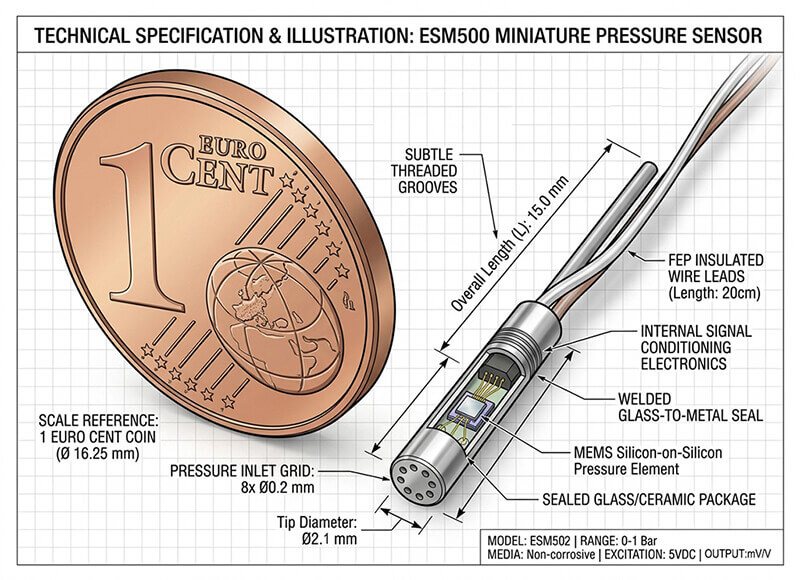
ESM500 Miniature Pressure Sensor
Silicon-on-Silicon | MEMES | Φ 2.1mm * 12mm | Absolute | Gauge | for Dynamic Pressure Measurement in Confined Spaces
Compact Size but Indispensable Performance
When engineers and researchers need to capture rapid pressure fluctuations in confined spaces, the choice of sensor can make or break their measurement accuracy. Whether you’re developing aerospace components, optimizing automotive systems, or pioneering medical devices, finding a miniature pressure sensor that delivers both high frequency response and exceptional sensitivity within a compact form factor remains a significant challenge.
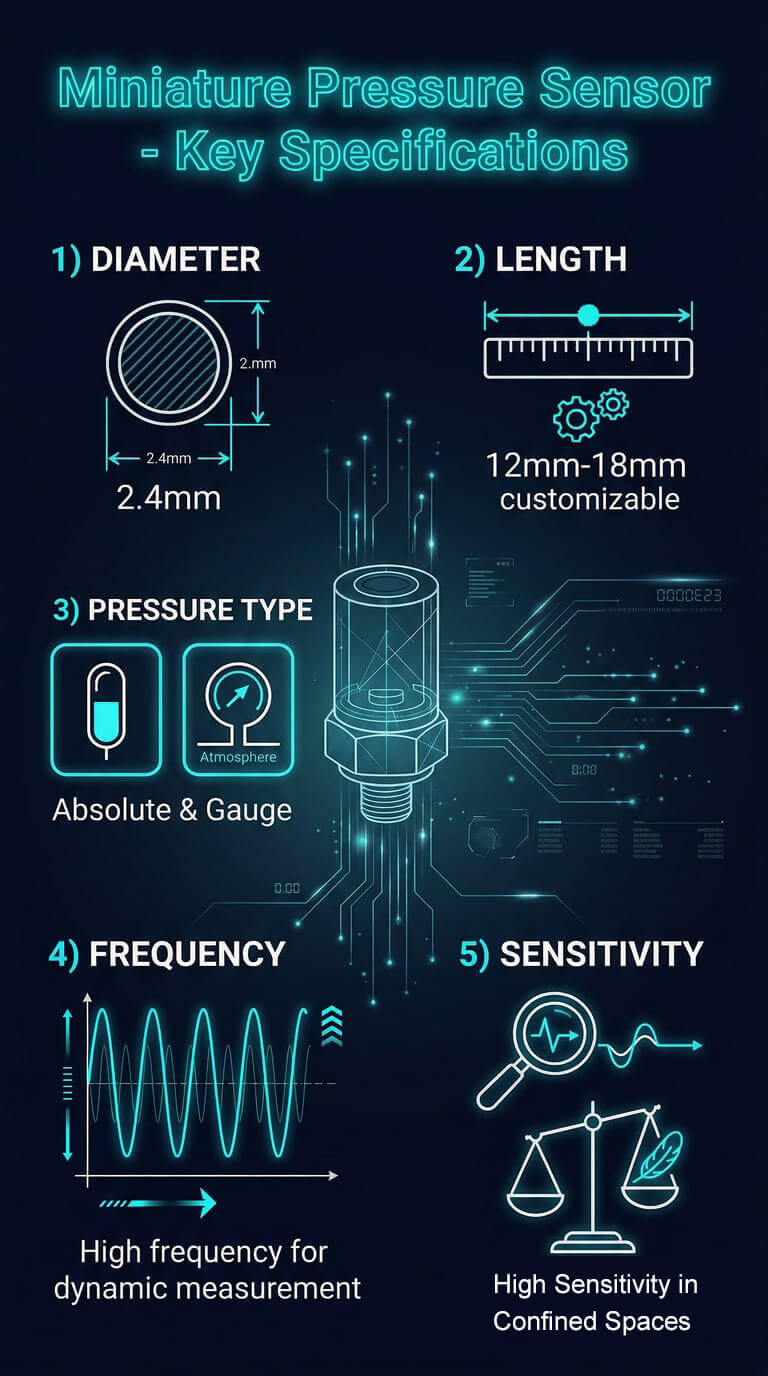
ESM500 serial miniature pressure sensors leverage MEMS (Micro-Electro-Mechanical Systems) technology to achieve remarkable performance characteristics in packages as small as 2.1 millimeters in diameter and 12mm length. This technology enables the production of sensors that combine high resonance frequencies—essential for capturing dynamic pressure events—with the stability and accuracy required for long-term monitoring applications.
Miniature Pressure Sensors Sensing Technologies
Based on MEMS (Micro-Electro-Mechanical Systems) sensing, ESM500 are serial of silicon-on-silicon miniature pressure sensors, the structural/mechanical components and the substrate are made from silicon material that offers several advantages for creating compact, high-performance pressure sensors.
Silicon-on-silicon technology typically uses piezoresistive elements diffused directly into the silicon diaphragm. This eliminates intermediate mechanical linkages or fluid-filled cavities that would introduce lag. The electrical resistance changes occur simultaneously with mechanical strain, providing a direct transduction path from pressure to electrical signal with bandwidth easily extending into the kilohertz range.
Applications that Commonly Need Miniature Pressure Sensors
Miniature pressure sensors have become indispensable components across multiple high-tech industries, particularly where space constraints meet the need for precise, real-time pressure data.
The global demand for smaller, more sensitive pressure transducers continues to grow as applications become increasingly sophisticated, from wind tunnel testing to implantable medical devices.
The fundamental advantage of miniature sensors lies in their ability to minimize flow disturbance while providing accurate measurements in environments where larger sensors would be impractical or impossible to install.
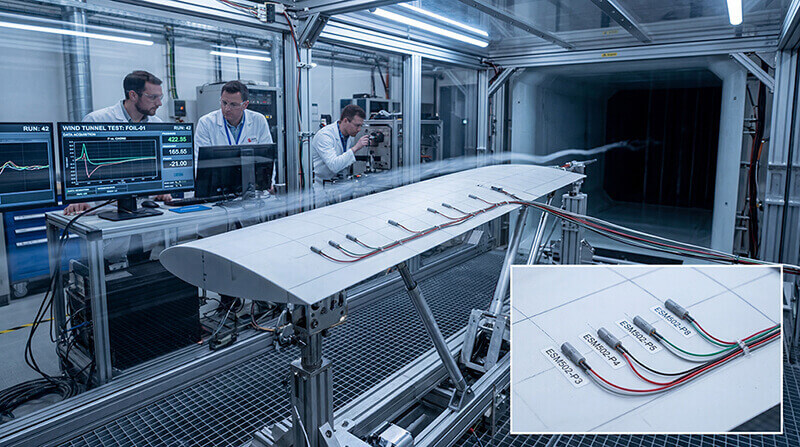
This is particularly critical in aerodynamic testing, where sensor size directly impacts the validity of pressure readings around airfoils and in confined ducts.
Similarly, in medical applications such as catheter-based diagnostics, the sensor must be small enough to navigate anatomical structures while maintaining the sensitivity required to detect subtle pressure changes.
Whether you need sensors for low-pressure monitoring or robust solutions for high-pressure environments, ESM500 miniature pressure sensors provide a reliable option, ensuring seamless integration into your designs.

1. What makes silicon-on-silicon technology better than other pressure sensor technologies?
Silicon-on-silicon construction bonds two precisely machined silicon wafers together, creating a hermetically sealed reference chamber without organic materials or adhesives. This delivers superior long-term stability, zero hysteresis, and excellent temperature compensation.
Unlike sensors using metal diaphragms or oil-filled capsules, the all-silicon design eliminates drift caused by material fatigue or fluid leakage. For confined space applications, you get reliable measurements over years without recalibration, even in harsh environments with temperature cycling or vibration.
2. How small can these sensors actually fit, and why does size matter for my application?
These miniature pressure sensors are available in packages as small as 2-3mm in diameter, with some custom versions even smaller. The compact size is critical for confined spaces because it minimizes flow disturbance and allows installation where traditional sensors cannot fit—inside pipelines, within medical devices, or embedded in aerodynamic surfaces. The small sensing diaphragm also means faster response times and higher frequency capability. You can measure pressure exactly where you need it without altering the system behavior or requiring extensive modifications to your test setup.
3. What frequency range can these sensors accurately measure?
Most silicon-on-silicon MEMS sensors handle frequencies from DC (static pressure) up to 10-50 kHz, with some specialized models reaching 100 kHz or higher. This covers virtually all industrial and research applications including turbulent flow analysis, combustion dynamics, acoustic measurements, and cardiovascular pressure waveforms. The high resonant frequency (typically 100-500 kHz) ensures flat frequency response without phase distortion across your measurement range. You can capture both slow trends and rapid transients with a single sensor, eliminating the need for multiple sensor types.
4. How sensitive are these sensors, and what's the smallest pressure change they can detect?
Sensitivity typically ranges from 0.01% to 0.1% of full scale, depending on the pressure range. For a 1 psi sensor, this means resolution down to 0.0001 psi or better. The low noise floor of silicon piezoresistive elements combined with integrated signal conditioning enables detection of minute pressure fluctuations that other technologies miss. This sensitivity is essential for applications like leak detection, subtle flow variations in microfluidics, or early detection of pressure anomalies in critical systems. You get actionable data from pressure changes that were previously invisible.
5. Can these sensors withstand high temperatures or harsh chemical environments?
Standard silicon-on-silicon sensors operate reliably from -40°C to +125°C, with high-temperature versions extending to +200°C or higher using specialized bonding techniques. The all-silicon, glass, and metal construction is inherently resistant to most gases and many liquids. For aggressive chemicals, sensors can be specified with chemically resistant diaphragm coatings or isolation techniques. However, you should always verify compatibility with your specific media. The robust construction means you can deploy these sensors in engine testing, industrial process monitoring, and other demanding environments where conventional sensors fail prematurely.
6. What accuracy and linearity can I expect over the operating range?
Total error band (including non-linearity, hysteresis, and repeatability) is typically ±0.25% to ±1.0% of full scale over the compensated temperature range. Non-linearity alone is often better than ±0.1% FSO. This exceptional linearity comes from the predictable elastic behavior of single-crystal silicon and the absence of mechanical linkages or fluid interfaces. You can trust the sensor output for precision control applications and scientific measurements without extensive calibration curves or complex correction algorithms. What you measure is what you get, with minimal uncertainty.
7. How do I mount these sensors in tight spaces without affecting measurements?
These sensors typically offer flush-mount or minimally protruding installation options specifically designed for confined spaces. The small profile allows mounting directly into a surface with the sensing diaphragm nearly flush, minimizing flow disruption. Many models include threaded ports, adhesive mounting provisions, or custom mounting adapters. The key is ensuring proper pressure port alignment and avoiding stress on the sensor body during installation, which could affect zero offset. Manufacturer-provided mounting kits and clear installation guidelines make integration straightforward even in challenging geometries.
8. What are the power requirements and output signal options?
Most sensors operate on 5-10V DC supply with current consumption of 1-10 mA, making them compatible with battery-powered data acquisition systems. Output options include amplified voltage (0-5V or ratiometric), 4-20mA current loop for industrial systems, or digital interfaces like I²C or SPI for embedded applications. The low power consumption is particularly valuable for portable measurement systems or implantable devices. You can select the output format that directly matches your existing data acquisition equipment without additional signal conditioning hardware.
9. How long do these sensors last, and what maintenance do they require?
Silicon-on-silicon sensors have no wearing parts and typically provide 10+ years of maintenance-free operation. The hermetically sealed design prevents contamination of the reference chamber, eliminating the drift and failure modes common in other technologies. Periodic verification against a reference standard is recommended for critical applications, but recalibration is rarely needed. The long-term stability means lower total cost of ownership—you avoid frequent replacements, minimize downtime, and reduce calibration expenses. For embedded or inaccessible installations, this reliability is essential.
10. What's the typical cost versus traditional pressure sensors, and is it worth it?
Silicon-on-silicon MEMS sensors typically cost 2-5 times more than basic pressure sensors but are often comparable to or less expensive than other high-performance technologies. The premium is justified by superior dynamic response, smaller size, better stability, and longer life. For confined space applications where traditional sensors cannot fit or fail prematurely, there’s no real alternative. Calculate total cost including installation difficulty, maintenance, calibration, and potential downtime—the MEMS sensor usually delivers better value. You pay more upfront but gain capabilities and reliability that solve problems conventional sensors cannot address.
Things Need to Consider When Selecting A Miniature Pressure Sensor
Pressure Range & Type
The sensor’s measurement range must match the application’s expected pressures. Determine whether the following type is needed.
- Absolute pressure (referenced to vacuum),
- Gauge pressure (referenced to atmospheric),
- Differential pressure (measuring the difference between two pressure points)
ESM502 is designed to measure absolute pressure from 50kpa to 4000kpa, while ESM503 is good to measure both absolute and gauge pressure from 50kpa to 3000kpa, both EMS502 and 503 can meet 2 times overpressure requirement.
Accuracy & Thermal Shift
Consider the level of precision required for the application. This includes the sensor’s total error band, non-linearity, hysteresis, and the smallest pressure change it can reliably detect. ESM500 serial provide 0.25%/FS accuracy for sensor and 0.5%/FS for transducer after signal amplified.
In Eastsensor, we guarantee 0.02%FS/℃~0.05%FS/℃ (±0.75% /100°F) which is the most standard and accepted thermal zero shift level.
Temperature Range
The miniature pressure sensor must operate reliably across the full temperature range of the application. This includes both the temperature of the measured media and the ambient environment.
Pay attention to the compensated temperature range where accuracy specifications are maintained versus the operating temperature range where the sensor functions but with reduced accuracy.
In view of ESM500 miniature pressure sensor, they are designed to work under temperature -40℃~+85℃ and can be customized to -55℃~+125℃ as per customer’s requirement.
Operating Environment
Consider exposure to vibration, shock, and electromagnetic interference that could affect performance, the miniature pressure sensor must withstand humidity levels and any corrosive or contaminating conditions it will encounter.
Response Time & Frequency
For dynamic measurements, determine how quickly the miniature pressure sensor responds to pressure changes and its bandwidth for measuring rapid pressure fluctuations, ESM500 can provide >200kHZ natural frequency.
Output signal & Power Requirements
ESM500 serial miniature pressure sensors offer various output types including mv output with 1.5mA or 12VDC power supply, analog voltage output 0-5V | 0-10V with 12-24V power supply, current loop output 4-20mA with 24V power supply. Ensure the output is compatible with the data acquisition system and that power supply requirements match available resources.
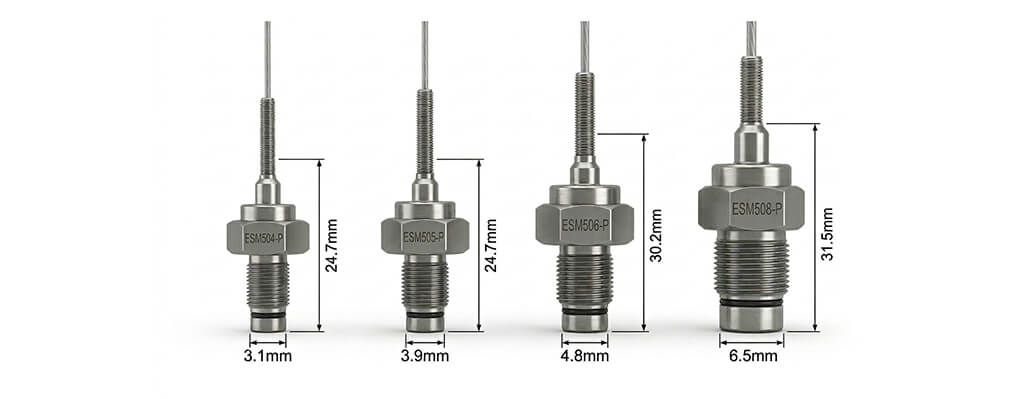
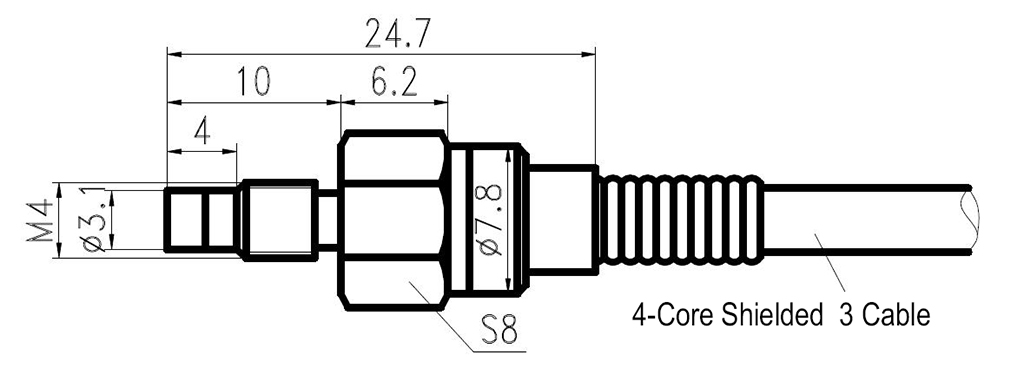
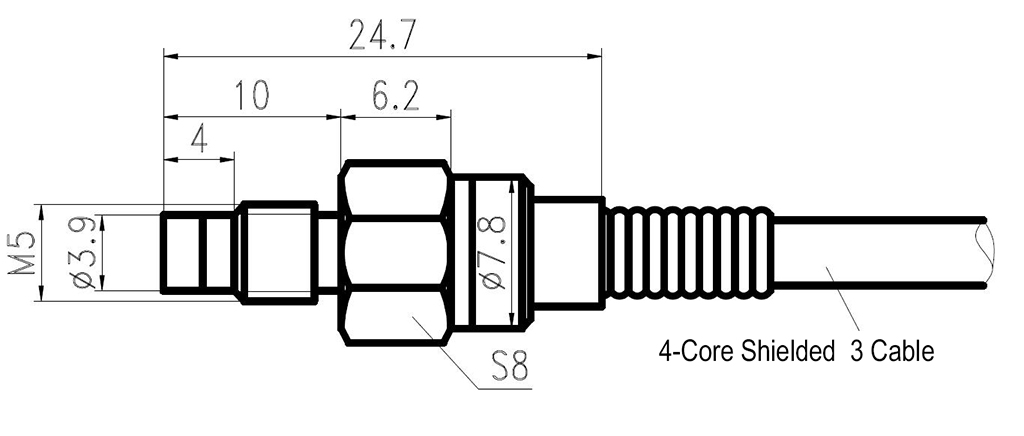
| ESM504-P Flush Diaphragm Miniature Pressure Sensor | ||||
|---|---|---|---|---|
| Range | 30bar/sg | 50bar/sg | 100bar/sg | 160bar/sg |
| Output | 5mV/V | 8mV/V | 10mV/V | 10mV/V |
| Frequency | 253KHz | 253KHz | 326KHz | 412KHz |
| Overpressure | 2X | |||
| Burst Pressure | 4X | |||
| Power Supply | 5V | 10V | |||
| None-linearity | ±0.5%/FS | |||
| Hysteresis | ±0.25%/FS | |||
| Repeatability | ±0.20%/FS | |||
| Working Temperature | -40~120℃(-40~250℉) | |||
| Compensate Temperature | 0~60℃(32~140℉) | |||
| Thermal Drift | ±0.04%FS/℃ | |||
| Diameter of Diaphragm | Φ3.1 | |||
| ESM505-P Flush Diaphragm Miniature Pressure Sensor | |||||
|---|---|---|---|---|---|
| Range | 25bar/sg | 50bar/sg | 100bar/sg | 160bar/sg | 200bar/sg |
| Output | 8mV/V | 10mV/V | 10mV/V | 10mV/V | 10mV/V |
| Frequency | 219KHz | 277KHz | 390KHz | 495KHz | 479KHz |
| Overpressure | 2X | ||||
| Burst Pressure | 4X | ||||
| Power Supply | 5V | 10V | ||||
| None-linearity | ±0.5%/FS | ||||
| Hysteresis | ±0.25%/FS | ||||
| Repeatability | ±0.20%/FS | ||||
| Working Temperature | -40~120℃(-40~250℉) | ||||
| Compensate Temperature | 0~60℃(32~140℉) | ||||
| Thermal Drift | ±0.04%FS/℃ | ||||
| Diameter of Diaphragm | Φ3.9 | ||||
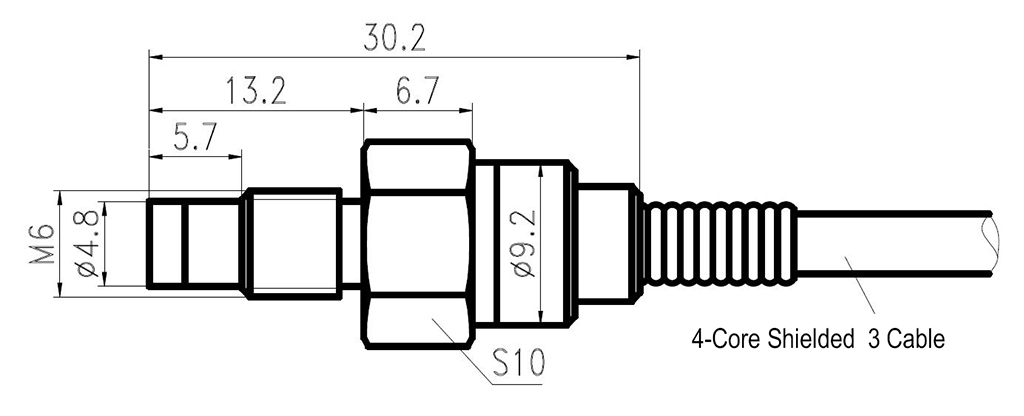
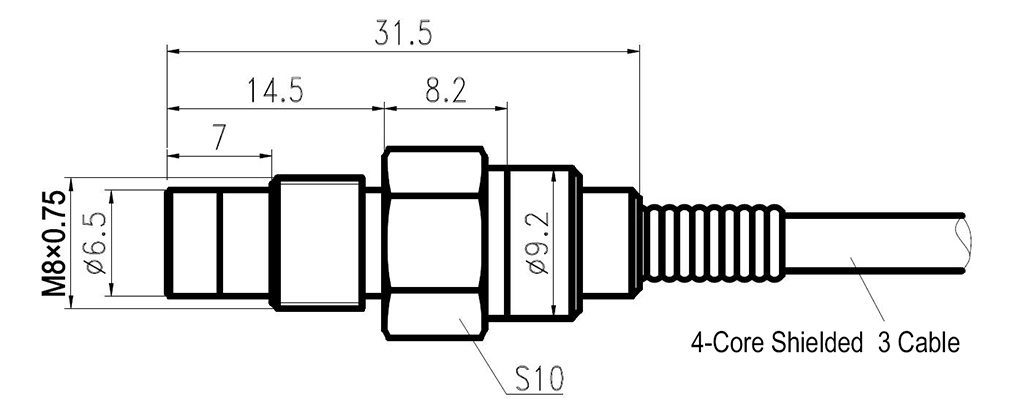
| ESM506-P Flush Diaphragm Miniature Pressure Sensor | ||||
|---|---|---|---|---|
| Range | 16bar/sg | 50bar/sg | 100bar/sg | 200bar/sg |
| Output | 8mV/V | 10mV/V | 10mV/V | 10mV/V |
| Frequency | 152KHz | 240KHz | 339KHz | 479KHz |
| Overpressure | 2X | |||
| Burst Pressure | 4X | |||
| Power Supply | 5V | 10V | |||
| None-linearity | ±0.5%/FS | |||
| Hysteresis | ±0.25%/FS | |||
| Repeatability | ±0.20%/FS | |||
| Working Temperature | -40~120℃(-40~250℉) | |||
| Compensate Temperature | 0~60℃(32~140℉) | |||
| Thermal Drift | ±0.03%FS/℃ | |||
| Diameter of Diaphragm | Φ4.8 | |||
| ESM508-P Flush Diaphragm Miniature Pressure Sensor | |||||
|---|---|---|---|---|---|
| Range | 5bar/sg | 10bar/sg | 16bar/sg | 200bar/sg | 250bar/sg |
| Output | 8mV/V | 10mV/V | 10mV/V | 10mV/V | 10mV/V |
| Frequency | 89KHz | 113KHz | 143KHz | 504KHz | 564KHz |
| Overpressure | 2X | ||||
| Burst Pressure | 4X | ||||
| Power Supply | 5V | 10V | ||||
| None-linearity | ±0.5%/FS | ||||
| Hysteresis | ±0.25%/FS | ||||
| Repeatability | ±0.20%/FS | ||||
| Working Temperature | -40~120℃(-40~250℉) | ||||
| Compensate Temperature | 0~60℃(32~140℉) | ||||
| Thermal Drift | ±0.03%FS/℃ | ||||
| Diameter of Diaphragm | Φ6.5 | ||||
ESM500-P Flush Diaphragm Miniature Pressure Sensor
MEMES | Φ 3.1mm ~Φ 6.5mm| Sealed Gauge | No Cavity Piezoresistive for both Dynamic & Static Pressure Measurement in Confined Space