Tuning Fork Density Meter-All You Need to Know
What is Tuning Fork Density Meter?
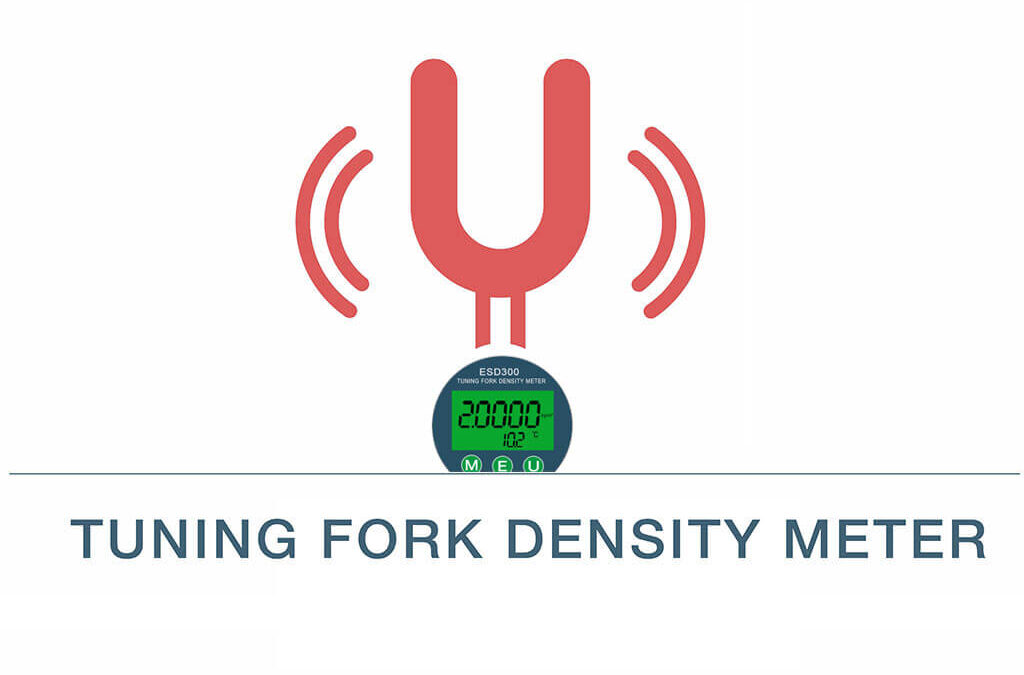
A tuning-fork density meter is an inline or immersion sensor that uses a vibrating dual-prong resonator to infer fluid density in real time.
Two piezoelectric crystals make the fork oscillate at its natural frequency and monitor the resulting vibration. When liquid or slurry surrounds the prongs, mass loading causes a predictable frequency shift;
Embedded electronics convert that shift into density, temperature-compensated and linearized. Unlike hydrometers or Coriolis meters, a tuning-fork density meter has no moving parts, needs a few milliliters of sample, and delivers fast, repeatable readings even with bubbly or viscous process streams—ideal for batching, blending and interface detection.
How Does a Tuning Fork Density Meter Measure Density?
At the heart of every tuning fork density meter is—no surprise—a miniature stainless-steel tuning fork.
One piezoelectric crystal excites the two prongs, while a second crystal listens. In air the fork vibrates at its natural resonant frequency, typically 1–2 kHz. Slide the probe into a liquid and the picture changes instantly: the fluid adds “mass loading,” damping the motion and pulling the frequency downward.
Here’s where the smart electronics step in. A phase-locked loop constantly tracks the live resonant frequency, maintaining oscillation with just enough drive to overcome fluid damping. The microprocessor then compares the measured frequency to factory calibration curves derived from air and water references. Because the frequency shift is nearly proportional to density, a simple polynomial—or in some models a neural lookup table—converts hertz into grams per cubic centimeter.
Temperature sensors mounted inside the fork provide real-time thermal correction, eliminating the need for external compensation. Viscosity has only a minor effect, so the tuning fork density meter stays accurate even when measuring syrups, glycol, or light slurries.
With no moving parts and only a few milliliters of wetted volume, the device delivers a fresh, fully compensated density value every 0.1–1 second—perfect for inline blending, custody transfer, or tight process control.
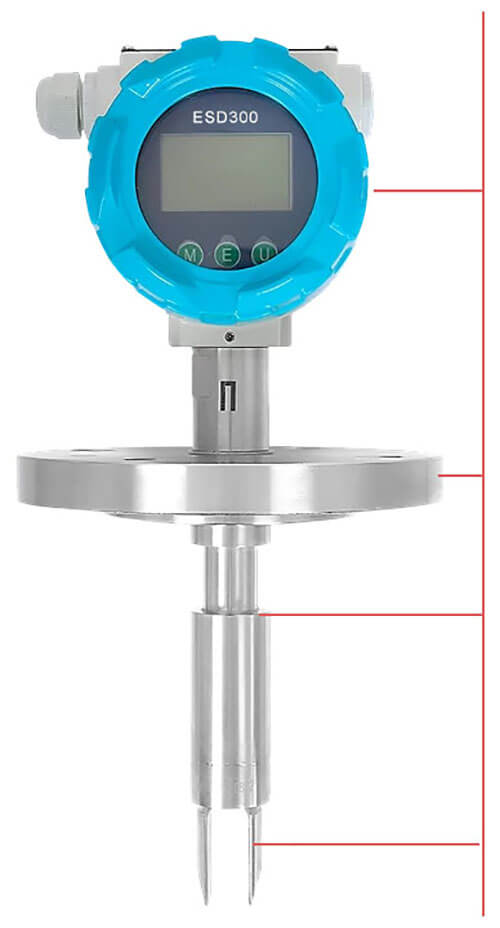
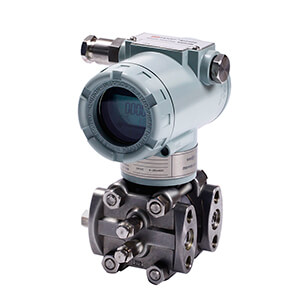
Integral transmitter with optional local operation interface
Process connection
Vibrating tines
RTD measures
Where the Tuning Fork Density Meter Used for?
Because it is compact, self-cleaning, and immune to flow rate, the tuning fork density meter has migrated far beyond the R&D lab and into a surprising variety of production environments.
- Chemical plants rely on it to verify the concentration of acids, caustics, glycols, and solvents in real time, allowing operators to close the loop on neutralization and dilution skids.
- In food and beverage, breweries check original gravity and final attenuation on the transfer line, while sugar refineries track Brix without the lag of grab-sample hydrometers.
- Oil & gas terminals mount the probe in custody-transfer lines to spot water breakthrough or interface layers between product batches; offshore separators fit them in the boot to control dehydration.
- LNG and LPG installations use cryogenic versions to determine energy content (density is a direct input to ISO 6578 mass-flow calculations).
- In pharmaceuticals, sanitary fork sensors with tri-clamps verify alcohol strengths, glycerin blends, and even live-culture broth density—all without disrupting sterile barriers.
- Mining and mineral processors monitor slurry solids on thickener underflow; tungsten-carbide-coated forks survive the abrasion most Coriolis tubes cannot.
- Power plants fit them in sulfuric acid scrubbers to maintain reagent strength, extending mist eliminator life.
- Finally, mobile service labs like biodiesel trucks carry battery-powered units for quick pass/fail checks in the field.
If your process needs continuous, maintenance-light density feedback and has limited straight pipe or footprint, a tuning fork density meter is almost certainly on the shortlist.
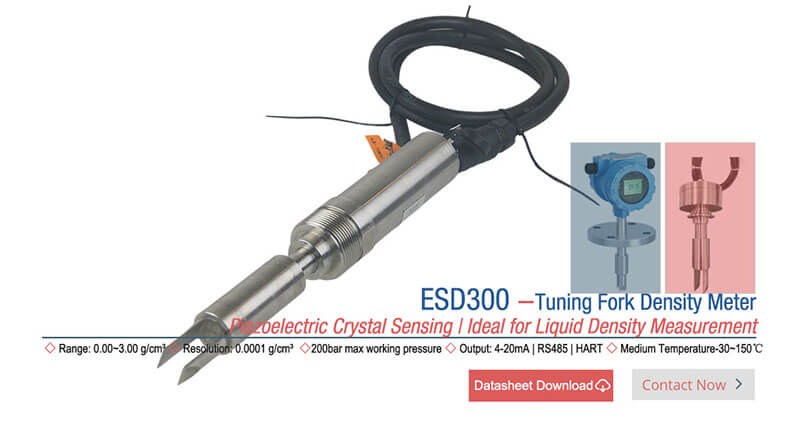
Tuning Fork Density Meter-What are the pros and cons
Knowing both sides of the coin helps you decide whether a tuning fork density meter is the right fit or if another technology—Coriolis, nuclear, hydrometer—would serve you better.
In short, a tuning fork density meter shines when you need quick, inline density data in a tight space and your fluid is neither ultra-viscous nor heavy with bubbles. If fouling is minimal and flow data isn’t mandatory, the pros will likely outweigh the cons for your application.
For details, the following table can show more specific.
| Pros | Cons |
|---|---|
| Fast response – new density every 0.1–1 s, perfect for batching and tight PID control. | Viscosity ceiling – liquids above ~10 000 cP overdamp the fork and may trigger drive-gain alarms. |
| Compact footprint – probe is no larger than a temperature sensor; needs virtually no straight pipe. | Coating sensitivity – scale or crystalline deposits shift the zero; periodic CIP or manual cleaning is essential. |
| No moving parts – vibrating prongs don’t wear, delivering 10-year MTBF in clean service. | Gas entrainment limit – >15 % entrained air can decouple vibration and falsify readings. |
| High repeatability – ±0.0002 g cm⁻³ rivals lab pycnometers once temperature is compensated. | No flow measurement – if you also need mass or volume flow, you’ll still require a separate meter. |
| Easy field calibration – two-point air/water trim restores factory accuracy in minutes. | Moderate temperature range – standard models cap at 200 °C; exotic alloys raise cost. |
| Lower cost than Coriolis – typically 30–50 % cheaper for the same line size. | Vibration pick-up – hard mounting near pumps or agitators can modulate the signal; isolation couplings may be needed. |
How Does The Flow Affect The Measurement?
Among the various influences that can skew a tuning fork density meter, none is more disruptive at the “edge” of its performance envelope than entrained gas. Here’s why it matters—and how to tame it.
When liquid is laced with bubbles, two things happen simultaneously:
- Mass-loading drops
Gas is roughly 1 ⁄ 800 the density of water, so a bubbly mixture “feels” lighter to the vibrating prongs than the true liquid phase. Even a 5 % volume of air can offset the reading by 0.02 g cm⁻³—enough to throw a chemical blend badly off spec. - Damping disappears
Bubbles compress and expand instead of viscously damping the fork. At about 15 % gas volume, the meter can no longer maintain resonance; you’ll see a drive-gain or “fork not oscillating” alarm in the diagnostics log.
Practical ways to minimize the edge effect:
- Install vertically so bubbles migrate away from the sensing gap instead of gathering around it.
- Add a stilling well or bypass loop where flow velocity is lower and gas disengages.
- Raise back-pressure with a control valve to keep dissolved gases in solution, especially on hot or flashing services.
- Enable advanced filtering—many transmitters offer bubble-reject algorithms that freeze the last good reading when oscillation amplitude becomes erratic.
Compared with other error sources—temperature drift, viscosity, coating—the impact of entrained gas is sudden and severe, turning a rock-solid tuning fork density meter into an unreliable gauge in seconds. Control the bubbles, and you’ll push the device right back to its lab-grade accuracy zone.
Can Tuning fork Density Meter Use In Slurry?
Short answer: yes—if you respect its design limits. A tuning fork density meter measures density by how much the surrounding medium “mass-loads” the vibrating prongs; solid particles suspended in liquid add mass just like liquid does, so the basic physics still works. That’s why you’ll find fork probes mounted on thickener underflow lines at copper mines or in gypsum slurry recirculation loops at power-plant scrubbers.
What to watch for:
- Particle size & abrasiveness
Fine kaolin or limestone behaves almost like a viscous liquid and poses little risk. Coarse, sharp minerals (e.g., silica sand) can erode standard 316 SS forks; opt for tungsten-carbide, Stellite, or HVOF coatings. - Solids concentration
Up to ~40 % w/w solids is usually fine. Beyond that, slurry viscosity climbs and damping may prevent the meter from sustaining resonance. - Settling & bridging
In low-flow areas solids can pack between the prongs, freezing them. Install the probe in a vertical spool piece where velocity remains ≥1 m s⁻¹, or add a purge/flush port for periodic cleaning. - Calibration tweaks
Slurry density is often quoted as “percent solids.” Most transmitters let you create a user table linking measured density to solids %. No secondary math needed in the DCS. - Maintenance reality
Even abrasion-resistant forks benefit from a quarterly visual check and ultrasonic bath to remove tenacious scale.
If you manage wear, buildup, and flow regime, a tuning fork density meter delivers fast, inline density (or solids) data without the radiation licensing of nuclear gauges and for a fraction of a Coriolis meter’s price tag—making it a smart choice for many slurry applications.
How to Install Tuning fork Density Meter?
How to Install a Tuning Fork Density Meter for Rock-Solid Readings
A tuning fork density meter is famously forgiving, but smart installation separates “pretty good” from “lab-grade” performance. Please keep these field-proven tips in mind:
1.Pick the right tap point
Locate the probe where the fluid is well mixed and representative—preferably downstream of a pump or static mixer, not in a dead leg or recirculation pocket. For slurry or multi-phase service, aim for line velocity ≥1 m s⁻¹ to keep solids and bubbles moving past the fork.
2. Mind the mounting orientation
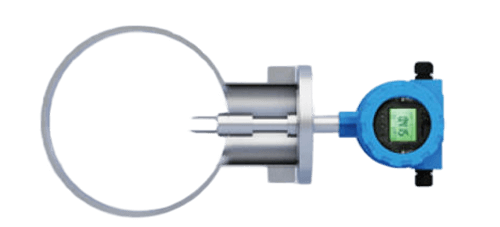
Vertical insertion with the prongs facing sideways lets gas rise away and solids fall through, preventing entrapment.
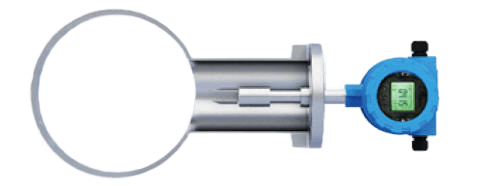
Horizontal mounting is acceptable for clean liquids but add a slight downward tilt (≈5°) so trapped air can escape.
3.Isolate external vibration
Pumps, gearboxes and agitators can modulate the resonant frequency. Install a short spool with elastomeric gaskets or a wafer-style vibration damper if mechanical noise exceeds 5 mm s⁻¹ RMS.

4.Provide service access
Use a two-inch or DN50 ball valve and a hot-tap nozzle so the probe can be withdrawn under pressure for calibration or cleaning—especially valuable in slurry and sticky food applications.
5.Cable and ground correctly
Run shielded signal cable in separate conduit away from VFD drives. Bond the fork head to plant ground to bleed off static on non-conductive products.
6.Allow thermal equilibration
Leave at least 150 mm of wetted stem inside the process so the integrated temperature sensor reflects true fluid temperature, ensuring accurate compensation.
7.Commission with a quick two-point trim
Once installed, run the transmitter’s “air” and “water” reference routine. This five-minute step erases shipping stresses and locks in factory accuracy.
Common Tuning Mistakes That Sabotage Accuracy
Even the best tuning fork density meter can look sloppy when its transmitter is tuned incorrectly. Below are the blunders field engineers see week after week—plus the quick fixes that restore “factory-fresh” performance.
| Mistake | What Goes Wrong | Fast Fix |
|---|---|---|
| Skipping air & water trim after installation | Shipping stresses or thread sealant tension shift the zero by up to 0.005 g cm⁻³. | Run the two-point reference routine before putting the loop in AUTO. |
| Trimming in a half-full pipe | Bubbles cling to the prongs, making the “water” point lighter than it really is. | Calibrate in a flooded, bubble-free section or a bucket of degassed water. |
| Ignoring temperature equilibrium | Fork is 30 °C cooler than the process; transmitter over-compensates. | Wait 5 minutes before pressing “STORE” or use a warm bath for the water point. |
| Using viscous oil for the span point | Viscosity alters damping; slope becomes non-linear. | Stick to clean water or a factory-specified calibration fluid. |
| Over-filtering the output | Heavy damping (τ > 10 s) masks real density swings, ruining tight control loops. | Start with τ = 1 s; increase only if pump noise causes nuisance trips. |
| Leaving “auto drive gain” disabled | Drive level drifts as fluid properties change; resonance is lost in high solids. | Keep auto-gain enabled and set alarm limits per the manual. |
| Forgetting to update fluid tables | Recipe reformulation means the density-to-concentration curve is obsolete. | Upload the new look-up table or polynomial whenever the product spec changes. |
Avoid these pitfalls and your tuning fork density meter will deliver the crisp, repeatable density values the datasheet promised—no excuses, no post-shift recalculations.
| Mistake | What Goes Wrong | Fast Fix |
|---|---|---|
| Skipping air & water trim after installation | Shipping stresses or thread sealant tension shift the zero by up to 0.005 g cm⁻³. | Run the two-point reference routine before putting the loop in AUTO. |
| Trimming in a half-full pipe | Bubbles cling to the prongs, making the “water” point lighter than it really is. | Calibrate in a flooded, bubble-free section or a bucket of degassed water. |
| Ignoring temperature equilibrium | Fork is 30 °C cooler than the process; transmitter over-compensates. | Wait 5 minutes before pressing “STORE” or use a warm bath for the water point. |
| Using viscous oil for the span point | Viscosity alters damping; slope becomes non-linear. | Stick to clean water or a factory-specified calibration fluid. |
| Over-filtering the output | Heavy damping (τ > 10 s) masks real density swings, ruining tight control loops. | Start with τ = 1 s; increase only if pump noise causes nuisance trips. |
| Leaving “auto drive gain” disabled | Drive level drifts as fluid properties change; resonance is lost in high solids. | Keep auto-gain enabled and set alarm limits per the manual. |
| Forgetting to update fluid tables | Recipe reformulation means the density-to-concentration curve is obsolete. | Upload the new look-up table or polynomial whenever the product spec changes. |
FAQs
What industries commonly use Tuning Fork Density Meters?
Key industries include petroleum and petrochemical, food and beverage, pharmaceutical, chemical processing, and quality control.
These meters are crucial for measuring liquid density in fuel analysis, product concentration monitoring, process control, and ensuring product quality across various manufacturing and research applications.
What are the advantages of Tuning Fork Density Meters over traditional methods?
Advantages include high precision (0.001 g/cm³), rapid measurement, non-destructive testing, minimal sample requirement, wide temperature and pressure range compatibility, low maintenance, and real-time monitoring capabilities. They offer superior accuracy compared to traditional hydrometers or pycnometers.
Can Tuning Fork Density Meters measure different types of liquids?
Yes, these meters can measure density across various liquid types, including: Water-like liquids, Aqueous solutions, Non-aqueous liquids, Viscous liquids, Suspended solids or opaque liquids
How often should I tune my density meter?
In clean service, yearly is sufficient. In crystallising or slurry service, plan quarterly checks or whenever the lab/LIMS flags a ≥0.001 g cm⁻³ discrepancy.
Can I tune in-situ without removing the probe?
You can do a zero check if the meter has an internal air chamber (some hygienic designs). Span requires a reference fluid; therefore, removal is safer and faster.
Does firmware update erase my calibration?
Most modern transmitters preserve coefficients in non-volatile memory. Still, export a backup before flashing new firmware.