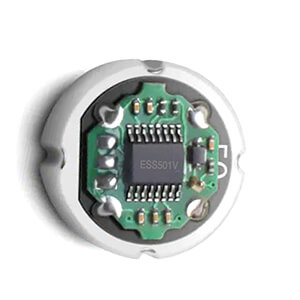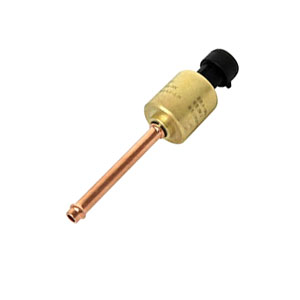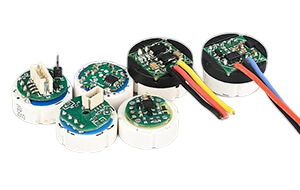
Ceramic Flush Diaphragm Sensor
Introduction
The global automotive sensor market is projected to reach $42.8 billion by 2027, driven by increasingly stringent emission standards and the rapid evolution of electric and autonomous vehicles.
At the heart of this transformation lies a critical component that most drivers never see but depend on every day : The Ceramic Flush Diaphragm Sensor.
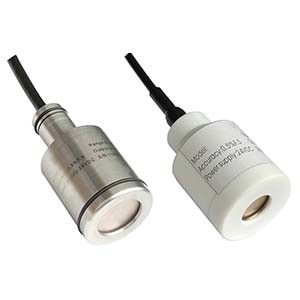
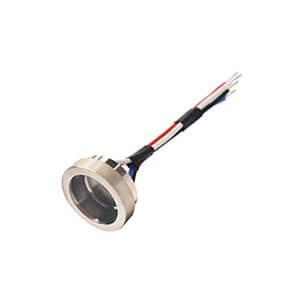
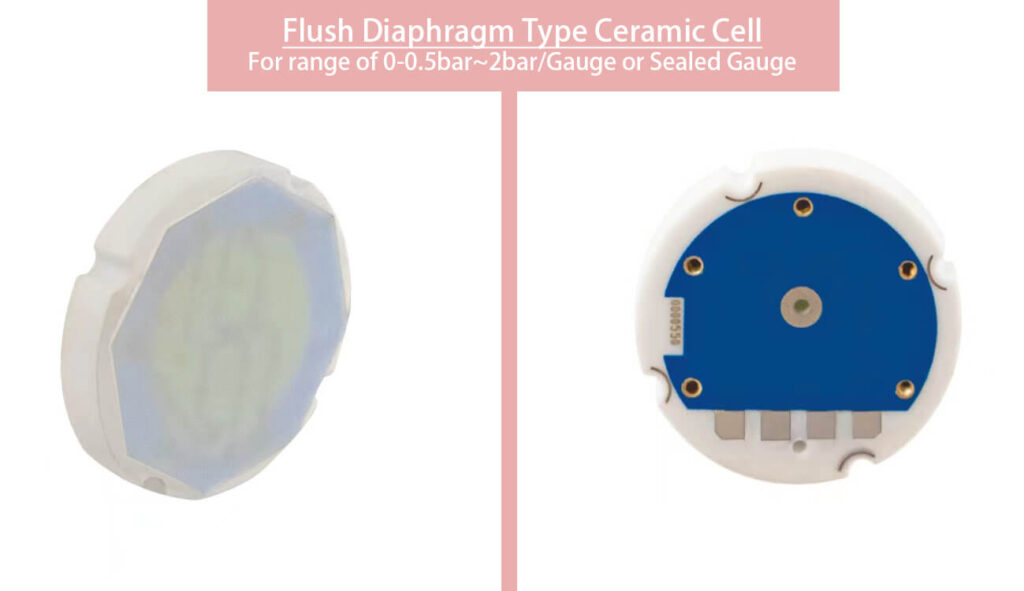
These pressure sensors represent a significant leap forward from traditional metal-based sensors. A ceramic flush diaphragm sensor features a flat, ceramic membrane that sits flush with the measuring surface, directly exposed to the media being measured.
Unlike conventional sensors with protruding elements, this flush-mount design eliminates dead spaces where particles or corrosive fluids can accumulate, making them ideal for the harsh environments found throughout modern vehicles.
As automotive systems become more complex—from precision fuel injection to sophisticated emission control and electric vehicle thermal management—the need for sensors that can withstand extreme temperatures, corrosive chemicals, and demanding accuracy requirements has never been greater.
In this article, we’ll explore how ceramic flush diaphragm sensors deliver superior chemical resistance, extreme temperature tolerance, exceptional durability, and cost-effective performance that’s revolutionizing automotive manufacturing and vehicle reliability.
Understanding Ceramic Flush Diaphragm Sensors
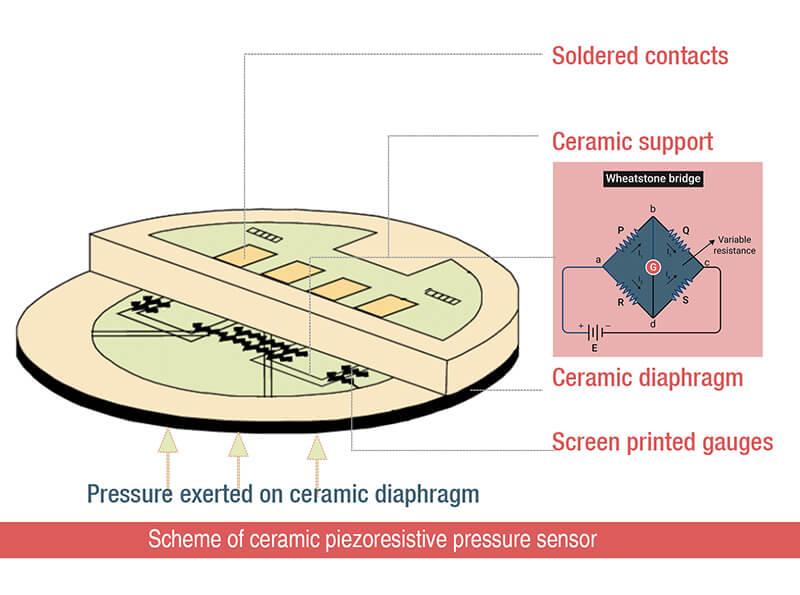
At its core, a ceramic flush diaphragm sensor is a precision instrument designed to measure pressure in demanding automotive environments. The sensor works by detecting the deflection of a thin ceramic diaphragm when pressure is applied. This deflection is converted into an electrical signal through piezoresistive elements embedded in the ceramic material, providing accurate real-time pressure readings that modern vehicle control systems rely upon.
What Sets Them Apart from Traditional Sensors
Traditional metal diaphragm sensors, like ESS3 Series, typically feature a stainless-steel membrane with a cavity or recess behind it.
While functional, in some cases, this design creates potential issues where media can become trapped, leading to measurement errors, corrosion, or clogging over time.
Ceramic flush diaphragm sensors eliminate this issue entirely.
Their diaphragm sits perfectly flush with the mounting surface, creating a smooth, gap-free interface with the measured medium. This seemingly simple design difference delivers profound benefits in automotive applications where sensors encounter everything from engine oil and coolant to exhaust gases and diesel particulate matter.
Key Components and Working Principle
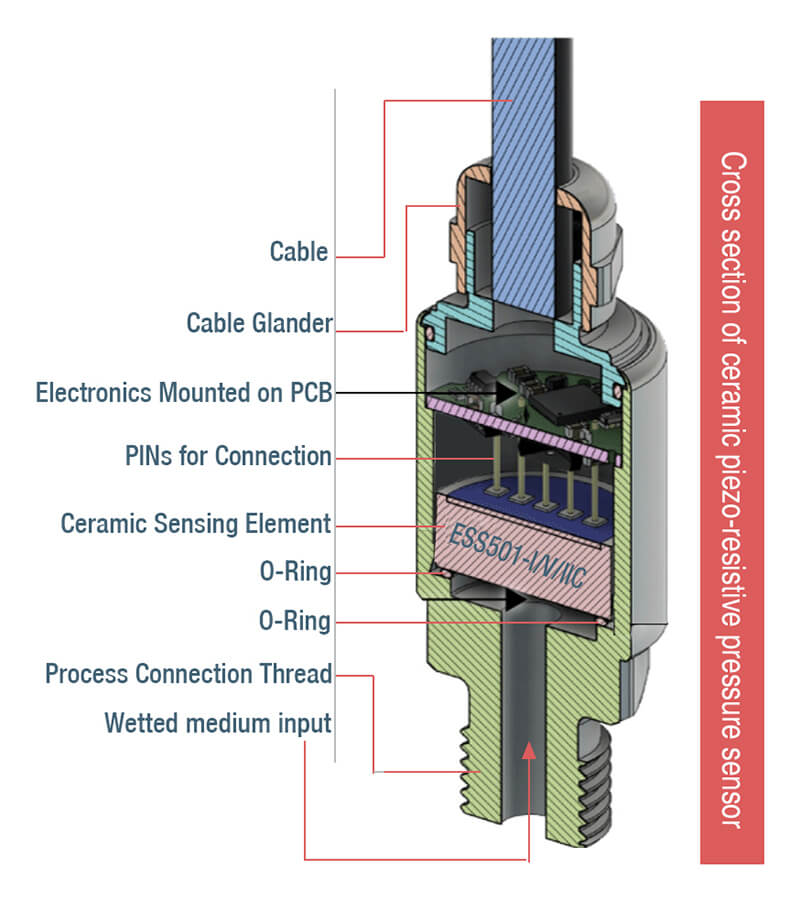
The sensor comprises three primary elements:
- The ceramic diaphragm itself (typically made from alumina or zirconia ceramics), piezoresistive measuring elements integrated into the ceramic substrate,
- A robust housing that protects the electronics while providing mechanical
- And electrical connections.
When pressure acts on the flush-mounted diaphragm, it deflects microscopically.
This mechanical deformation changes the electrical resistance of the piezoresistive elements, creating a measurable voltage signal proportional to the applied pressure.
Advanced signal conditioning circuits then convert this raw signal into standardized outputs compatible with automotive electronic control units (ECUs).
| ESS502-I | ESS502-V | ESS502-IIC | |
|---|---|---|---|
| Power supply | 10-36V | 5V | 2.7-5.5V |
| Signal output | 4-20 mA | 0.5-4.5V | I2C |
Click to find details: Amplified Ceramic Pressure Sensor
Common Automotive Applications
These sensors have become indispensable across numerous vehicle systems.
In diesel engines, they monitor exhaust backpressure and diesel particulate filter status to optimize emission control. Fuel injection systems rely on them for precise rail pressure measurement, ensuring optimal combustion efficiency. They’re equally critical in brake systems for ABS and ESP functionality, transmission control for smooth gear changes, and increasingly in electric vehicles for battery cooling system management and thermal regulation.
| Sensor Type | Function | ECU use |
|---|---|---|
| MAP (Manifold Absolute Pressure) Sensor | Measures pressure and vacuum in the intake manifold. | In naturally aspirated engines, the ECU uses MAP data as a primary load input to determine the air-fuel ratio. In turbocharged or supercharged engines, the ECU uses MAP data to manage boost pressure. |
| Fuel Pressure Sensor | Monitors fuel pressure in the fuel rail or fuel line. | The ECU uses this data to adjust fuel pump operation and injector timing to maintain correct fuel pressure. In high-performance applications, it helps with injector pressure differential tuning. |
| Oil Pressure Sensor | Measures oil pressure inside the engine. | The ECU monitors this data for engine protection. For example, some ECUs can be programmed to reduce engine speed if oil pressure drops below a safe level, preventing engine damage. |
| Exhaust Pressure Sensor | Measures pressure of exhaust gases, often used in conjunction with a Diesel Particulate Filter (DPF). | The ECU uses this data to monitor the DPF's condition and control regeneration cycles. For tuning applications, it can be used to measure exhaust backpressure. |
Their versatility and reliability make them the sensor of choice wherever accurate pressure measurement meets harsh operating conditions.
7 Major Benefits for the Automotive Industry
Superior Chemical Resistance
Ceramic materials possess an inherent chemical inertness that makes them virtually impervious to the harsh fluids found throughout modern vehicles. Unlike metal sensors that can corrode when exposed to acidic brake fluids, glycol-based coolants, or sulfur-containing diesel fuel, ceramic flush diaphragm sensors maintain their structural integrity and measurement accuracy even after years of continuous exposure.
This chemical resistance is particularly crucial in modern automotive applications where fluid formulations have become increasingly complex. Brake fluids containing aggressive corrosion inhibitors, extended-life coolants with advanced additive packages, and biofuel blends with higher water content all pose significant challenges to traditional sensor materials. Ceramic sensors handle these media without degradation, maintaining consistent performance throughout their service life.
Extreme Temperature Tolerance
The engine compartment represents one of the most thermally challenging environments in any vehicle, with temperatures routinely swinging from sub-zero cold starts to sustained operation above 120°C.
Ceramic flush diaphragm sensors are engineered to operate reliably across temperature ranges from -40°C to 135°C, with specialized variants capable of even wider extremes 140°C ~150°C.
| Working voltage | 2-30V DC |
|---|---|
| Impedance | 10.0KΩ±30% |
| Sensitivity | 2.0-4.0mV/V/FS, typical: 3.0 mV/V/FS |
| TCR | ≤100ppm/℃@-40℃~135℃ |
| Offset | 0±0.4mV/V |
| Working temperature | -40℃~135℃ |
| Storage temperature | -40℃~140℃ |
| Thermal offset shift | Tco&Tcs 0.02%FS/℃ Max |
| Non linearity | 0.25%FS Max |
| Hysteresis & repeatability | 0.25%FS Max |
| Response time | <2ms |
| Lifetime & reliability test | >5 million, 0bar -nominal pressure cycle |
| Long term stability | <0.25%FSO @25℃ (No time to accumulate) |
| Insulation | >2KV |
High Accuracy and Stability
Direct fuel injection systems require pressure measurements accurate to within 1-2% to optimize combustion efficiency and minimize emissions. Variable geometry turbochargers need precise boost pressure feedback for smooth power delivery. Advanced brake systems rely on accurate pressure sensing for features like emergency brake assist and adaptive cruise control.
Ceramic flush diaphragm sensors excel in delivering this precision. Their rigid ceramic structure exhibits minimal hysteresis—the tendency for measurements to differ depending on whether pressure is increasing or decreasing—and exceptional repeatability.
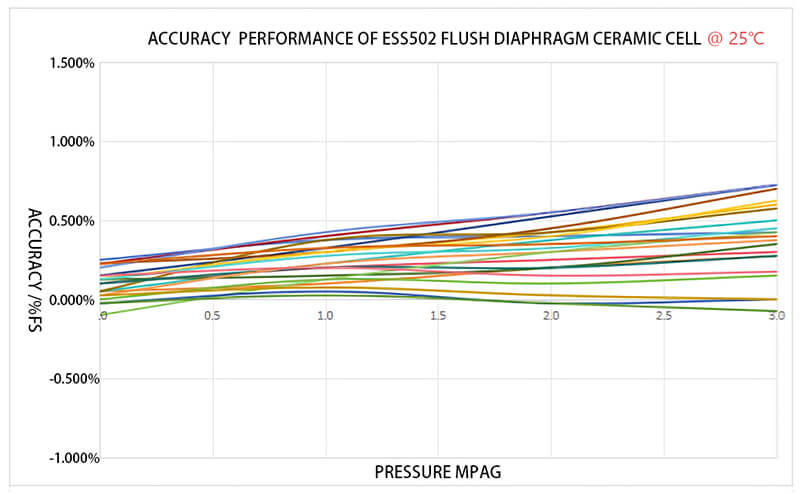
Independent testing has demonstrated that quality ceramic sensors can maintain accuracy specifications within ±0.5% of full scale over millions of pressure cycles, a level of performance that metal sensors struggle to match.
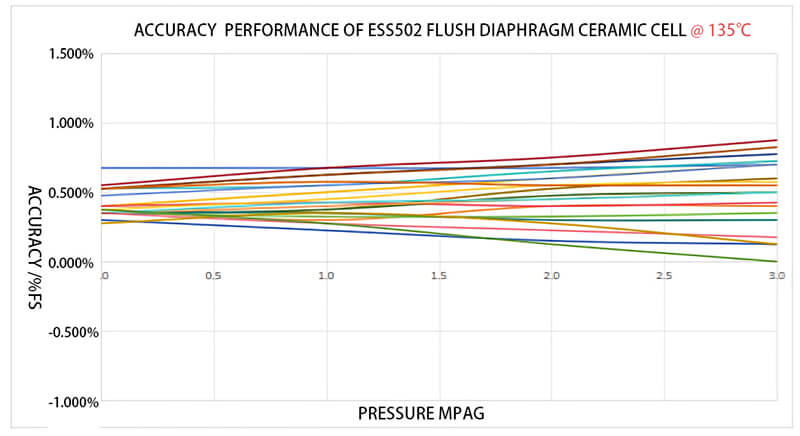
What is more, ceramic materials are dimensionally stable and resist the creep and fatigue that plague metal diaphragms. This stability ensures that a ceramic sensor installed during vehicle assembly will still meet original accuracy specifications at the end of the vehicle’s service life, potentially 15 years or more later.
Media Compatibility
The automotive industry’s push toward cleaner emissions have introduced sensors to increasingly hostile measurement environments.
- Exhaust gas recirculation systems expose sensors to hot, particle-laden gases containing acids and condensates.
- Diesel particulate filter monitoring requires measuring pressure across soot-loaded filters where conventional sensors would quickly clog or fail.
- Selective catalytic reduction systems use corrosive urea solutions that attack metal components.
Ceramic flush diaphragm sensors address these challenges through both material selection and design philosophy. The ceramic diaphragm itself resists corrosion from acidic condensates and abrasion from particulate matter. Equally important, the flush-mount design eliminates cavities where particles can accumulate or liquids can pool.
In DPF applications, this means the sensor continues to provide accurate differential pressure readings even as soot loading increases, enabling precise regeneration control that optimizes fuel economy while protecting the filter from damage.
This media compatibility extends to emerging applications as well. As manufacturers explore alternative fuels including hydrogen blends and synthetic fuels, ceramic sensors provide the chemical resistance needed to handle these new media without requiring extensive revalidation or redesign.
Compact Design and Easy Integration
Modern vehicle design is an exercise in packaging optimization.
Every cubic centimeter under the hood is contested between powertrain components, emission control systems, cooling infrastructure, and electronic modules. The flush-mount design of ceramic diaphragm sensors provides a significant advantage in this space-constrained environment.

Traditional sensors with protruding sensing elements or protective housings require mounting bosses, clearance zones, and sometimes dedicated mounting brackets. Ceramic flush sensors can be integrated directly into existing component surfaces—cast into an engine block, machined into a fuel rail, or incorporated into a manifold design—with minimal additional space requirements. The result is cleaner packaging, fewer potential leak points, and reduced overall system weight.
Installation simplicity translates directly to manufacturing efficiency. Sensors that thread directly into tapped ports without adapters or additional sealing components reduce assembly time and eliminate potential points of failure.

For manufacturers producing thousands of vehicles daily, even saving 30 seconds per sensor installation multiplies into meaningful production efficiency gains. Additionally, the robust ceramic construction tolerates reasonable installation torque variations without damage, reducing the risk of assembly errors that could compromise sensor performance or create warranty claims.
Enhanced Durability and Reliability
Vehicle sensors must endure conditions that would destroy most electronic devices. Continuous vibration from engine operation, shock loads from rough roads, thermal cycling between temperature extremes, and exposure to moisture, salt spray, and environmental contaminants all take their toll on sensor longevity.
Ceramic materials offer inherent advantages in this demanding environment. The high stiffness-to-weight ratio of ceramic diaphragms makes them naturally resistant to vibration-induced fatigue.
Accelerated life testing conducted by automotive suppliers has demonstrated ceramic sensor mean-time-between-failures (MTBF) figures exceeding one million hours of operation—effectively a lifetime warranty for automotive applications.
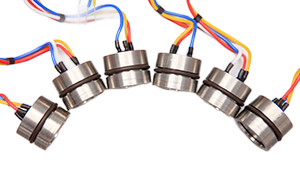
Below pic show how we do life testing toward ESS502 Ceramic Flush Diaphragm Sensor
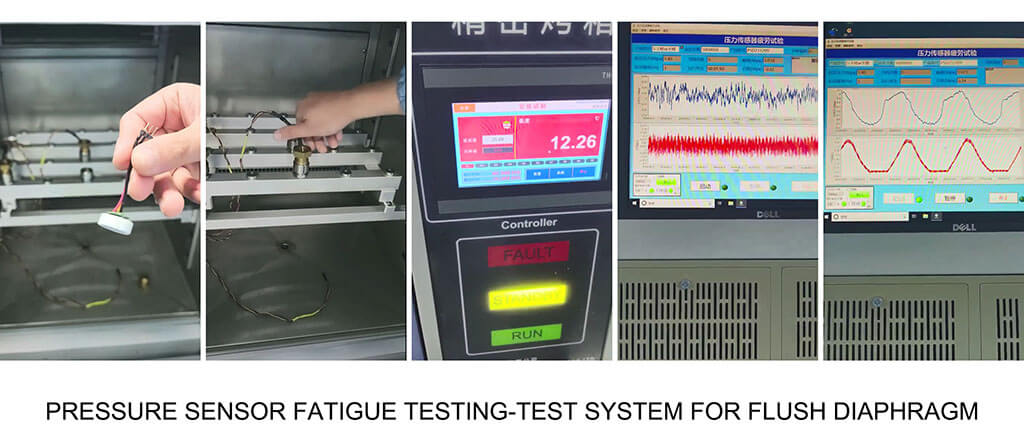
This exceptional reliability has profound implications for automotive manufacturers and vehicle owners alike. Reduced sensor failure rates decrease warranty claims, improve brand reputation for reliability, and enhance customer satisfaction.
Compliance with Automotive Standards
Ceramic flush diaphragm sensors are engineered from the ground up to meet these demanding standards. Their inherent stability and reliability simplify the qualification process, while their accuracy and long-term performance ensure that emission control systems function as designed throughout the vehicle’s regulatory useful life—typically 150,000 miles or more. This is particularly critical for emissions-critical sensors where failure could cause a vehicle to exceed regulatory limits, potentially triggering recalls or regulatory penalties.
Specific Automotive Applications
Ceramic flush diaphragm sensors have become integral components across virtually every major vehicle system, enabling the precision control that modern automobiles demand.
Engine Management Systems
Within engine management, ceramic sensors monitor manifold absolute pressure (MAP), providing the engine control unit with critical data for calculating optimal fuel delivery and ignition timing.
Transmission Control
Modern automatic transmissions rely on precise hydraulic pressure control for smooth, efficient gear changes. Ceramic flush diaphragm sensors monitor line pressure, clutch pack pressures, and torque converter lockup circuits, providing the transmission control module with the data needed for seamless shifting.
Brake Systems (ABS, ESP)
Safety-critical brake systems demand absolute reliability, making ceramic sensors the preferred choice for ABS wheel speed correlation and electronic stability program applications. These sensors monitor brake line pressure with millisecond response times, enabling rapid intervention when wheel lockup or vehicle instability is detected.
Fuel Injection Systems
Direct injection gasoline and common rail diesel systems operate at pressures exceeding 2,000 bar, requiring sensors that combine extreme pressure capability with exceptional accuracy. Ceramic flush diaphragm sensors monitor fuel rail pressure, providing feedback that enables precise injection timing and quantity control.
Exhaust Gas Recirculation (EGR)
EGR systems reduce nitrogen oxide emissions by recirculating a portion of exhaust gases back into the intake manifold. Ceramic sensors monitor differential pressure across EGR valves and coolers, enabling precise control of recirculation rates.
Turbocharger Boost Pressure Monitoring
Turbocharged engines rely on accurate boost pressure measurement to prevent over-boosting that could damage the engine while maximizing performance potential. Ceramic sensors positioned in the intake manifold or compressor outlet provide real-time feedback for wastegate or variable geometry turbo control.
Climate control systems use ceramic sensors to monitor refrigerant pressures, ensuring efficient operation while protecting compressors from damaging pressure extremes. The sensors enable automatic climate control systems to optimize cooling performance while minimizing energy consumption—an increasingly important consideration in electric vehicles where HVAC loads directly impact driving range.
Battery Cooling Systems in Electric Vehicles
Electric vehicle battery packs require precise thermal management to optimize performance, longevity, and safety.
Ceramic flush diaphragm sensors monitor coolant pressure in battery cooling circuits, ensuring adequate flow rates while detecting potential leaks or blockages. Their electrical isolation properties are particularly valuable in high-voltage battery environments, while their reliability ensures consistent thermal management throughout the battery’s service life, protecting this expensive and critical component.
What makes ceramic flush diaphragm sensors better than traditional metal sensors for automotive applications?
Ceramic sensors offer three key advantages over metal alternatives.
First, they’re chemically inert,
Second, their flush-mount design eliminates dead spaces where particles or contaminants can accumulate, preventing clogging and measurement errors.
Third, ceramic materials maintain their accuracy over millions of pressure cycles without the drift or fatigue.
Can ceramic flush diaphragm sensors work reliably in electric vehicles?
Absolutely!
In fact, ceramic sensors are particularly well-suited for electric vehicles.
They excel in EV battery thermal management systems, monitoring coolant pressure to ensure optimal battery temperature control—critical for battery longevity and performance.
Their electrical isolation properties make them safe for use in high-voltage environments, and they require no special considerations when installed near battery packs or power electronics.
As EVs eliminate traditional engine applications, ceramic sensors are increasingly used in brake systems, HVAC, and battery cooling circuits where their reliability and accuracy provide significant value.
What is the typical lifespan of a ceramic flush diaphragm sensor in automotive use?
Quality ceramic flush diaphragm sensors are designed to last the entire vehicle lifetime, typically 15-20 years or 150,000-200,000 miles, without requiring replacement.
Unlike traditional sensors that may need replacement every 5-7 years due to corrosion or drift, ceramic sensors maintain their accuracy and reliability throughout their service life.
Are ceramic flush diaphragm sensors compatible with older vehicle models and legacy systems?
Yes, ceramic flush diaphragm sensors are highly compatible with both modern and legacy automotive systems.
They typically use standard electrical connections and signal outputs (analog voltage, current loop, or digital protocols) that integrate seamlessly with existing engine control units and vehicle networks.
Do ceramic flush diaphragm sensors require special maintenance or calibration?
No special tools, procedures, or periodic maintenance schedules are required. Once installed, these sensors provide reliable, accurate measurements until eventual vehicle retirement, making them ideal for sealed systems or hard-to-access locations where maintenance access is limited.
How do ceramic sensors perform in extreme weather conditions like severe cold or desert heat?
Ceramic flush diaphragm sensors are specifically engineered for extreme environmental conditions. They operate reliably from -40°C to 135°C or higher, covering the full range of automotive operating environments from Arctic winters to desert summers.
In Conclusion
Ceramic flush diaphragm sensors represent a transformative technology that addresses the automotive industry’s most pressing challenges: improving reliability, meeting stringent emissions standards, and reducing total cost of ownership.
As vehicle systems grow increasingly sophisticated and regulatory requirements continue tightening, the question is no longer whether to implement ceramic sensor technology, but how quickly to integrate it across all applications.
We encourage automotive engineers and procurement specialists to contact us or other ceramic sensor suppliers, request detailed specifications for your specific applications, and explore integration opportunities.