
Seawater Level Sensor Built to Survive Saltwater — Not Just Measure It
The problem: Standard sensors corrode, foul, and fail within months in saltwater — costing you downtime, replacements, and data gaps during critical operations.
The result: A marine-rated seawater level sensor that delivers reliable readings for 10–15+ years in ballast tanks, harbors, offshore platforms, and desalination plants.
Your benefit: Stop budgeting for sensor replacements every season. Get traceable accuracy, corrosion-proof titanium construction, and 4-20mA integration your crew already understands — all backed by 15+ years of marine engineering.
Seawater Level Sensor: What You Need to Know
A seawater level sensor is a specialized instrument engineered to measure liquid level in saltwater environments where standard sensors fail within months. Unlike freshwater sensors, it uses titanium or Hastelloy wetted parts, IP68 submersible sealing, and biofouling-resistant design to deliver reliable readings for 10–15+ years.
Whether you call it a marine level sensor, saltwater level transmitter, or submersible seawater level probe, the right choice depends on five factors: material compatibility, accuracy class, sensor technology, output signal, and environmental rating.
- Core technology: Hydrostatic pressure measurement dominates marine applications — no moving parts, proven reliability
- Must-have specs: Titanium diaphragm, IP68, 4-20mA output, ±0.25% FS accuracy, density compensation
- Top applications: Ballast tanks, harbor/tide monitoring, offshore platforms, desalination, aquaculture
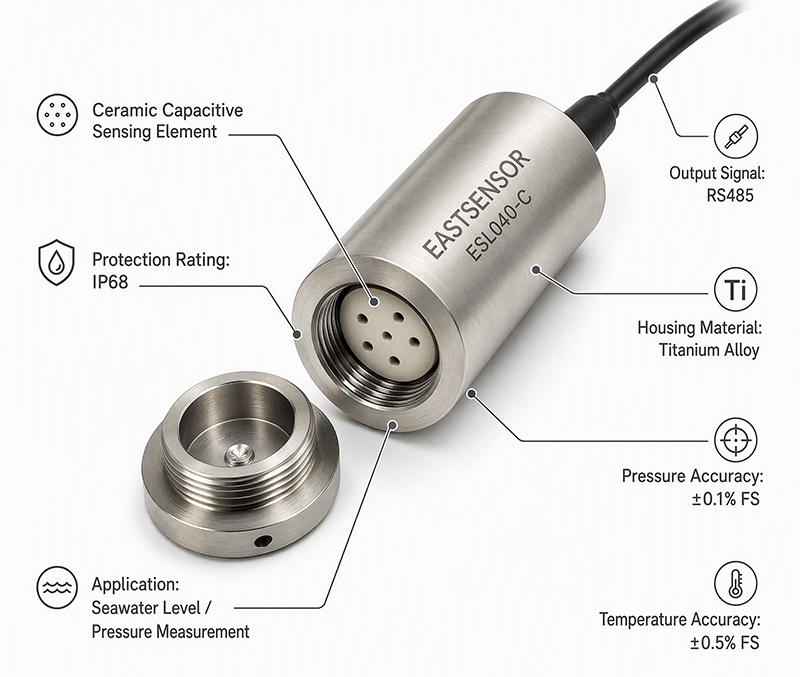
- Recommended product: ESL040-C Seawater Level Transmitter — engineered for continuous saltwater submersion
- Quick quote: Email [email protected] with your application details
What Makes Seawater Level Measurement Different
Here's what most engineers don't realize until they've experienced a failure: seawater is one of the most aggressive measurement environments you'll ever encounter. A standard freshwater level sensor might seem like it would work — after all, water is water, right? Wrong. Within months, corrosion destroys the diaphragm. Salt deposits block measurement ports. Electrical connections fail. And if that sensor fails during a storm surge or critical ballast operation, the "savings" from a cheaper sensor become extremely expensive.
That's why marine engineers, shipbuilders, and coastal monitoring professionals specifically choose a seawater level sensor — an instrument purpose-built to survive saltwater while delivering the accuracy the application demands. For a deeper dive into the measurement principles, see our related guide on seawater level measurement methods.
The Five Challenges You're Actually Fighting
Corrosion acceleration: Saltwater attacks most metals relentlessly. What takes years in freshwater happens in months. Standard 316 stainless steel — fine in freshwater — pits and corrodes rapidly in continuous seawater exposure.
Biofouling: Marine organisms love submerged surfaces. Barnacles, algae, and biofilm colonize sensors, blocking measurement ports and creating false readings that compromise your entire monitoring system.
Density variations: Seawater density (1.025 g/cm³) differs from freshwater (1.000 g/cm³). A sensor calibrated for freshwater shows 2.5% error in seawater. Temperature and salinity shifts compound this — a critical concern for pressure-based saltwater level transmitters.
Wave action and surge: Marine environments involve constant motion. Your sensor must deliver stable readings despite waves, ship motion, and tidal surges that would destabilize lesser instruments.
Electrical conductivity: Seawater conducts electricity, creating ground loops, accelerating galvanic corrosion, and causing sensor failures unless properly addressed in the electrical design.
The reality: Standard industrial sensors fail in seawater — not immediately, but predictably. Marine-rated sensors cost more upfront because they address these specific challenges through material selection, sealing design, and construction methods that prevent premature failure.
Sensor Technologies for Marine Environments
Four proven approaches — each with distinct strengths for seawater applications
Hydrostatic Pressure
No moving parts, direct measurement, handles turbulence. Requires density compensation and corrosion-proof diaphragm.
Ultrasonic
No contact with corrosive seawater. Easy maintenance. Temperature and wave action can affect accuracy.
Radar
Unaffected by temperature, pressure, foam, or vapor. Highest accuracy in harsh conditions. Higher cost.
Float-Based
Density-independent, simple operation, visual indication. Moving parts vulnerable to fouling and wear.
A sensor that drifts 2mm per year seems trivial — but over 10 years, that's 20mm of systematic error in your sea level record. In marine measurement, long-term stability isn't a luxury. It's the difference between data you trust and data that quietly lies to you.
Key Specifications That Actually Matter
Engineers waste hours comparing datasheets. For a seawater level sensor, here's what deserves your attention — and what doesn't.
Material Compatibility: The Foundation
Wetted materials — the parts physically touching seawater — determine sensor longevity. Standard 304 stainless corrodes rapidly. 316L works for housings but has limitations for diaphragms. For critical or long-term submersion, specify titanium or Hastelloy C. For non-metallic alternatives, PVDF/Kynar and ceramic offer excellent corrosion and abrasion resistance.
Common mistake: Assuming "stainless steel" means "seawater compatible." It doesn't. Even 316 stainless pits over time. For any permanent marine installation, titanium wetted parts are the professional standard — and exactly what the ESL040-C seawater level transmitter delivers.
Accuracy: Understanding What Matters in Your Application
Higher accuracy costs more. Specify based on actual requirements, not "better is better" thinking. For overflow prevention, ±0.5% FS probably suffices. For ballast system control, ±0.25% is standard. For research or precise harbor monitoring, ±0.1% may be necessary. Ask yourself: "What decision changes if my reading is off by X amount?" That answer tells you the accuracy you actually need.
Environmental Ratings That Protect Your Investment
IP67 means temporary immersion — minimum for marine electronics. IP68 means continuous submersion — required for any submersible seawater level probe. IP69K handles high-pressure washdown for deck-mounted equipment. Always specify temperature range with margin: a sensor rated to 50°C gives safety headroom for tropical installations where ambient hits 40°C.
Critical Specs at a Glance
Material Seawater Resistance
Accuracy Tiers (10m depth)
Data based on continuous seawater submersion. Material performance varies with temperature, salinity, and flow conditions.
Output Signal Comparison for Marine Installations
Choose the right signal type for your monitoring system
| Signal Type | Advantages | Marine Considerations | Best Use Case |
|---|---|---|---|
| 4-20mA★ Recommended | Noise immunity, long cable runs, industry standard | Best for distances >10m, electrically noisy ship environments | Ballast systems, ship-wide monitoring |
| 0-10V / 0-5V | Simple interface, common DAQ compatibility | Keep cable runs short, avoid high-noise areas | Research, short-run DAQ systems |
| RS485 / Modbus | Multiple sensors on bus, diagnostics, digital data | Requires communication expertise, more complex setup | Multi-sensor networks, offshore platforms |
| NMEA 0183/2000 | Marine navigation system standard | Direct integration with ship bridge systems | Vessel navigation integration |
How to Select the Right Seawater Level Sensor
Based on hundreds of marine installations
Define Your Measurement Range and Accuracy Needs
Measure minimum and maximum levels exactly. Determine the normal operating range where you need best accuracy. Ask: "What decision changes if my reading is off by X?" That tells you the accuracy class you need.
Assess Environmental Conditions
Be brutally honest about operating conditions — temperature range, salinity (Baltic vs. Red Sea differs hugely), turbidity, submersion type (continuous, intermittent, splash zone), and maintenance accessibility.
Choose Appropriate Technology
Match sensor technology to application: pressure sensors for ballast and enclosed tanks, radar for large cargo tanks, ultrasonic for bilge and overflow detection.
Select Materials for Your Seawater Type
316L for general harbor use (housings only). Titanium for all wetted parts in harsh or long-term conditions. Remember: flowing seawater is more aggressive than static — upgrade accordingly.
Match Output Signal to Your System
Existing 4-20mA system → specify current loop. Voltage DAQ → voltage output. Ship navigation → NMEA. New multi-sensor network → consider RS485/Modbus bus topology.
Plan Installation Requirements
Specify mounting (threaded, flanged, submersible), cable length and type (vented for gauge pressure), power supply voltage, and — critically — ensure maintenance access is possible for periodic cleaning.
Making Your Decision: A Final Checklist
Submersible Seawater Level Probe
Engineered for Continuous Saltwater Submersion
The ESL040-C is a marine-grade seawater level sensor designed specifically for the harshest saltwater environments. With a titanium diaphragm, IP68 submersible construction, and 4-20mA output, it delivers reliable level measurement in ballast tanks, harbor monitoring stations, offshore platforms, and desalination plants — where standard sensors fail within months.
Ready to Solve Your Seawater Level Measurement Challenge?
Get application-specific recommendations from our marine engineering team. Whether you need a single sensor for a research project or hundreds for a fleet installation, we deliver solutions that survive marine environments — and provide the data you need.
FAQ: Seawater Level Sensor
10 most common questions — answered concisely