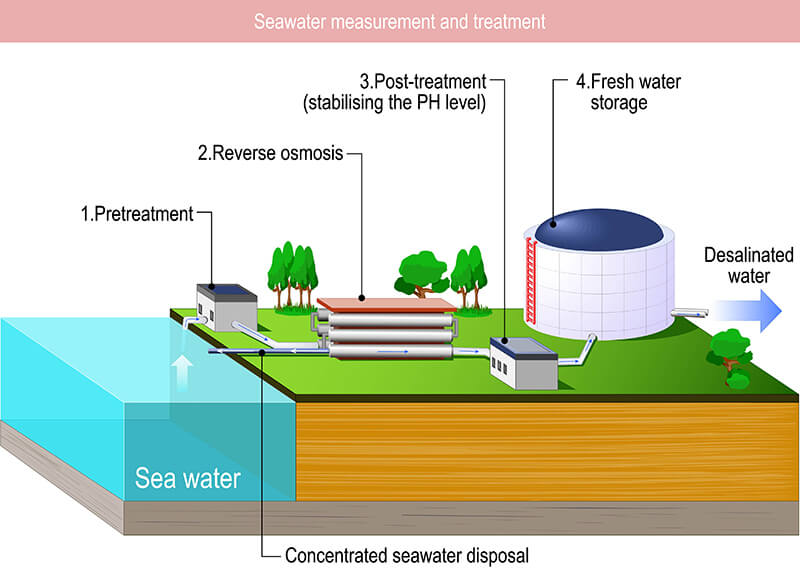
Seawater Level Sensor Guide

Seawater Level Sensor Guide

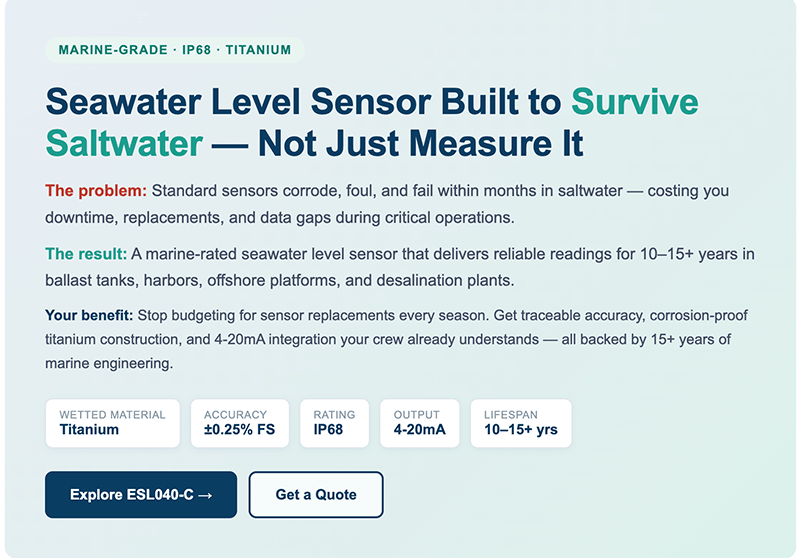
Marine-Grade · IP68 · Titanium

Seawater Level Sensor Built to Survive Saltwater — Not Just Measure It

The problem: Standard sensors corrode, foul, and fail within months in saltwater — costing you downtime, replacements, and data gaps during critical operations.

The result: A marine-rated seawater level sensor that delivers reliable readings for 10–15+ years in ballast tanks, harbors, offshore platforms, and desalination plants.

Your benefit: Stop budgeting for sensor replacements every season. Get traceable accuracy, corrosion-proof titanium construction, and 4-20mA integration your crew already understands — all backed by 15+ years of marine engineering.

Wetted MaterialTitanium
Accuracy±0.25% FS
RatingIP68
Output4-20mA
Lifespan10–15+ yrs
⚡ TL;DR — 30 Second Summary

Seawater Level Sensor: What You Need to Know

A seawater level sensor is a specialized instrument engineered to measure liquid level in saltwater environments where standard sensors fail within months. Unlike freshwater sensors, it uses titanium or Hastelloy wetted parts, IP68 submersible sealing, and biofouling-resistant design to deliver reliable readings for 10–15+ years.

Whether you call it a marine level sensor, saltwater level transmitter, or submersible seawater level probe, the right choice depends on five factors: material compatibility, accuracy class, sensor technology, output signal, and environmental rating.

  • Core technology: Hydrostatic pressure measurement dominates marine applications — no moving parts, proven reliability
  • Must-have specs: Titanium diaphragm, IP68, 4-20mA output, ±0.25% FS accuracy, density compensation
  • Top applications: Ballast tanks, harbor/tide monitoring, offshore platforms, desalination, aquaculture
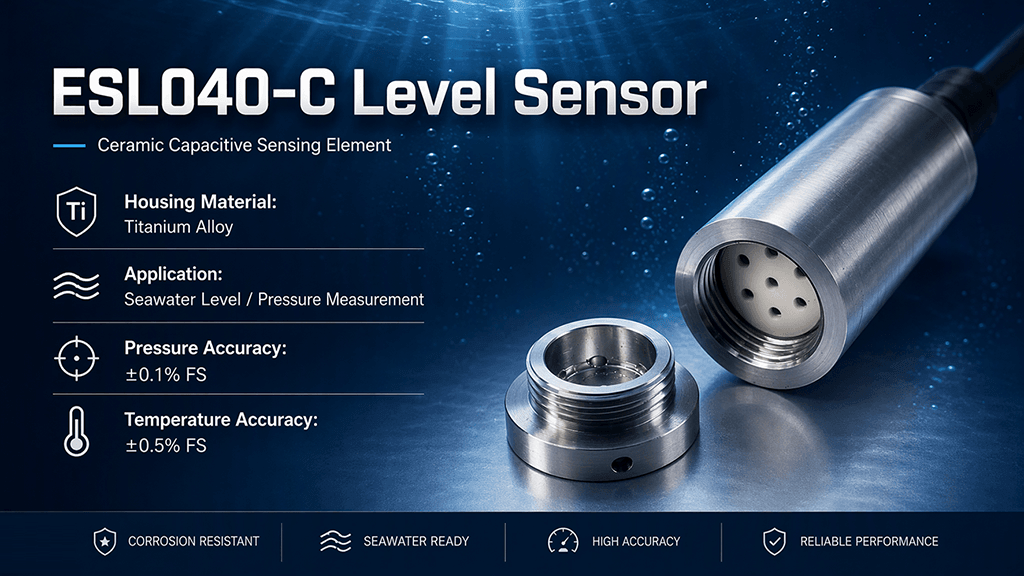
  • Recommended product: ESL040-C Seawater Level Transmitter — engineered for continuous saltwater submersion
  • Quick quote: Email [email protected] with your application details

What Makes Seawater Level Measurement Different

Here's what most engineers don't realize until they've experienced a failure: seawater is one of the most aggressive measurement environments you'll ever encounter. A standard freshwater level sensor might seem like it would work — after all, water is water, right? Wrong. Within months, corrosion destroys the diaphragm. Salt deposits block measurement ports. Electrical connections fail. And if that sensor fails during a storm surge or critical ballast operation, the "savings" from a cheaper sensor become extremely expensive.

That's why marine engineers, shipbuilders, and coastal monitoring professionals specifically choose a seawater level sensor — an instrument purpose-built to survive saltwater while delivering the accuracy the application demands. For a deeper dive into the measurement principles, see our related guide on seawater level measurement methods.

The Five Challenges You're Actually Fighting

Corrosion acceleration: Saltwater attacks most metals relentlessly. What takes years in freshwater happens in months. Standard 316 stainless steel — fine in freshwater — pits and corrodes rapidly in continuous seawater exposure.

Biofouling: Marine organisms love submerged surfaces. Barnacles, algae, and biofilm colonize sensors, blocking measurement ports and creating false readings that compromise your entire monitoring system.

Density variations: Seawater density (1.025 g/cm³) differs from freshwater (1.000 g/cm³). A sensor calibrated for freshwater shows 2.5% error in seawater. Temperature and salinity shifts compound this — a critical concern for pressure-based saltwater level transmitters.

Wave action and surge: Marine environments involve constant motion. Your sensor must deliver stable readings despite waves, ship motion, and tidal surges that would destabilize lesser instruments.

Electrical conductivity: Seawater conducts electricity, creating ground loops, accelerating galvanic corrosion, and causing sensor failures unless properly addressed in the electrical design.

The reality: Standard industrial sensors fail in seawater — not immediately, but predictably. Marine-rated sensors cost more upfront because they address these specific challenges through material selection, sealing design, and construction methods that prevent premature failure.

Sensor Technologies for Marine Environments

Four proven approaches — each with distinct strengths for seawater applications

★ Top Choice
🌊

Hydrostatic Pressure

No moving parts, direct measurement, handles turbulence. Requires density compensation and corrosion-proof diaphragm.

Best for: Ballast tanks, harbor monitoring, offshore platforms
Non-Contact
📡

Ultrasonic

No contact with corrosive seawater. Easy maintenance. Temperature and wave action can affect accuracy.

Best for: Bilge detection, open tanks, overflow alarms
Premium
📶

Radar

Unaffected by temperature, pressure, foam, or vapor. Highest accuracy in harsh conditions. Higher cost.

Best for: Large cargo tanks, chemical carriers, critical measurement
Simple
🔘

Float-Based

Density-independent, simple operation, visual indication. Moving parts vulnerable to fouling and wear.

Best for: On/off switches, backup systems, simple indication
"

A sensor that drifts 2mm per year seems trivial — but over 10 years, that's 20mm of systematic error in your sea level record. In marine measurement, long-term stability isn't a luxury. It's the difference between data you trust and data that quietly lies to you.

Eastsensor Engineering Team — 15+ years of marine instrumentation experience

Key Specifications That Actually Matter

Engineers waste hours comparing datasheets. For a seawater level sensor, here's what deserves your attention — and what doesn't.

Material Compatibility: The Foundation

Wetted materials — the parts physically touching seawater — determine sensor longevity. Standard 304 stainless corrodes rapidly. 316L works for housings but has limitations for diaphragms. For critical or long-term submersion, specify titanium or Hastelloy C. For non-metallic alternatives, PVDF/Kynar and ceramic offer excellent corrosion and abrasion resistance.

Common mistake: Assuming "stainless steel" means "seawater compatible." It doesn't. Even 316 stainless pits over time. For any permanent marine installation, titanium wetted parts are the professional standard — and exactly what the ESL040-C seawater level transmitter delivers.

Accuracy: Understanding What Matters in Your Application

Higher accuracy costs more. Specify based on actual requirements, not "better is better" thinking. For overflow prevention, ±0.5% FS probably suffices. For ballast system control, ±0.25% is standard. For research or precise harbor monitoring, ±0.1% may be necessary. Ask yourself: "What decision changes if my reading is off by X amount?" That answer tells you the accuracy you actually need.

Environmental Ratings That Protect Your Investment

IP67 means temporary immersion — minimum for marine electronics. IP68 means continuous submersion — required for any submersible seawater level probe. IP69K handles high-pressure washdown for deck-mounted equipment. Always specify temperature range with margin: a sensor rated to 50°C gives safety headroom for tropical installations where ambient hits 40°C.

Critical Specs at a Glance

Material Seawater Resistance

TitaniumExcellent
Hastelloy CExcellent
PVDF / KynarExcellent
CeramicExcellent
316L StainlessGood (housing only)
316 StainlessFair (short-term)
304 StainlessPoor — avoid

Accuracy Tiers (10m depth)

±0.1% FS → ±10mmResearch grade
±0.25% FS → ±25mmBallast control
±0.5% FS → ±50mmOverflow prevention
±1.0% FS → ±100mmNon-critical only
IP68 RatingRequired
Expected Lifespan10–15+ years

Data based on continuous seawater submersion. Material performance varies with temperature, salinity, and flow conditions.

Output Signal Comparison for Marine Installations

Choose the right signal type for your monitoring system

Signal Type Advantages Marine Considerations Best Use Case
4-20mA★ Recommended Noise immunity, long cable runs, industry standard Best for distances >10m, electrically noisy ship environments Ballast systems, ship-wide monitoring
0-10V / 0-5V Simple interface, common DAQ compatibility Keep cable runs short, avoid high-noise areas Research, short-run DAQ systems
RS485 / Modbus Multiple sensors on bus, diagnostics, digital data Requires communication expertise, more complex setup Multi-sensor networks, offshore platforms
NMEA 0183/2000 Marine navigation system standard Direct integration with ship bridge systems Vessel navigation integration

How to Select the Right Seawater Level Sensor

Based on hundreds of marine installations

1

Define Your Measurement Range and Accuracy Needs

Measure minimum and maximum levels exactly. Determine the normal operating range where you need best accuracy. Ask: "What decision changes if my reading is off by X?" That tells you the accuracy class you need.

2

Assess Environmental Conditions

Be brutally honest about operating conditions — temperature range, salinity (Baltic vs. Red Sea differs hugely), turbidity, submersion type (continuous, intermittent, splash zone), and maintenance accessibility.

3

Choose Appropriate Technology

Match sensor technology to application: pressure sensors for ballast and enclosed tanks, radar for large cargo tanks, ultrasonic for bilge and overflow detection.

4

Select Materials for Your Seawater Type

316L for general harbor use (housings only). Titanium for all wetted parts in harsh or long-term conditions. Remember: flowing seawater is more aggressive than static — upgrade accordingly.

5

Match Output Signal to Your System

Existing 4-20mA system → specify current loop. Voltage DAQ → voltage output. Ship navigation → NMEA. New multi-sensor network → consider RS485/Modbus bus topology.

6

Plan Installation Requirements

Specify mounting (threaded, flanged, submersible), cable length and type (vented for gauge pressure), power supply voltage, and — critically — ensure maintenance access is possible for periodic cleaning.

Making Your Decision: A Final Checklist

Technical Requirements
Measurement range confirmed (min/max levels, not assumptions)
Accuracy spec appropriate for application needs
Material compatibility verified for actual seawater conditions
Temperature rating exceeds operating extremes with margin
Pressure rating handles depth + surge conditions
Marine Environment Compatibility
IP68 rating for submersion or splash zone exposure
Corrosion resistance adequate for seawater type
Biofouling mitigation strategy defined
Physical protection from impact addressed
Hazardous area certification if needed (ATEX, IECEx)
Integration & Installation
Output signal matches monitoring/control system
Cable length and type specified correctly
Power supply voltage compatible
Mounting configuration suits installation location
Maintenance access planned for periodic cleaning
Recommended Product
ESL040-C

Submersible Seawater Level Probe

Engineered for Continuous Saltwater Submersion

The ESL040-C is a marine-grade seawater level sensor designed specifically for the harshest saltwater environments. With a titanium diaphragm, IP68 submersible construction, and 4-20mA output, it delivers reliable level measurement in ballast tanks, harbor monitoring stations, offshore platforms, and desalination plants — where standard sensors fail within months.
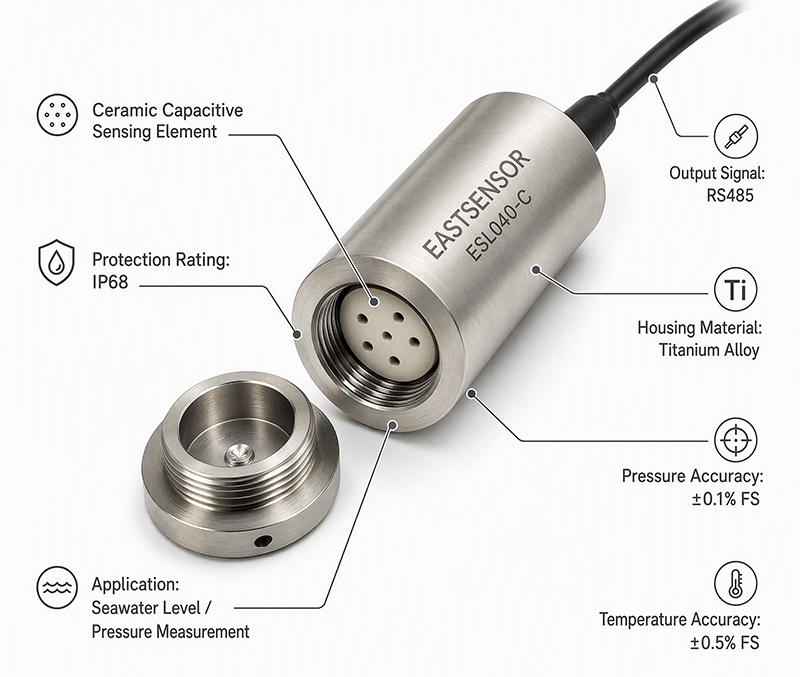
Wetted MaterialTitanium
Accuracy±0.25% FS
ProtectionIP68
Output4-20mA
Power Supply12–36 VDC
Temperature-20 to 70°C

Ready to Solve Your Seawater Level Measurement Challenge?

Get application-specific recommendations from our marine engineering team. Whether you need a single sensor for a research project or hundreds for a fleet installation, we deliver solutions that survive marine environments — and provide the data you need.

15+ years marine experience Titanium construction IP68 rated Global shipping

FAQ: Seawater Level Sensor

10 most common questions — answered concisely
What makes a seawater level sensor different from a freshwater sensor?
Seawater sensors require corrosion-resistant materials (titanium, Hastelloy), enhanced sealing against salt intrusion, and biofouling mitigation. Standard freshwater sensors fail within months due to corrosion and seal degradation in saltwater.
Can I use a standard pressure sensor in seawater?
No, not for permanent installations. Standard sensors may work briefly, but corrosion causes failure within months. Marine-rated saltwater level transmitters cost more upfront but provide reliable service for 10–15+ years.
How does seawater density affect level measurement?
Pressure sensors calculate level as Pressure ÷ (Density × Gravity). Seawater density (1.025 g/cm³) differs from freshwater (1.000 g/cm³), causing 2.5% error. Temperature and salinity changes require density compensation.
What is the best sensor technology for ballast tank monitoring?
Hydrostatic pressure sensors dominate ballast applications. They offer accuracy across wide ranges, handle turbulence, need minimal maintenance, and integrate easily via 4-20mA outputs. Titanium diaphragms resist corrosion.
How often do seawater level sensors need maintenance?
Tropical biologically active waters: monthly inspection, quarterly cleaning. Temperate waters: quarterly inspection, semi-annual cleaning. Cold waters: semi-annual inspection, annual cleaning. Enclosed tanks: annual inspection typically suffices.
Will barnacles or marine growth affect sensor accuracy?
Yes, significantly. Fouling blocks pressure ports, adds weight to floats, and creates false surfaces for ultrasonic/radar sensors. Prevention includes copper alloy components, antifouling coatings, and regular cleaning schedules.
What materials resist seawater corrosion best?
Ranked: Titanium (excellent, forms protective oxide layer), Hastelloy C (excellent, superior chemical resistance), PVDF/Kynar (excellent non-metallic), 316L stainless (good for housings), ceramic (excellent but brittle). Avoid 304 stainless.
Can seawater level sensors work in hazardous areas?
Yes. For cargo tanks with flammable products or chemical carrier vapor spaces, sensors need ATEX (Europe) or IECEx (international) certification. Specify intrinsically safe designs or explosion-proof housings based on area classification.
How do I prevent ground loops in marine installations?
Ground current loops at the receiver (PLC/controller) only, not at the sensor. Use shielded cables, ground shields at one end, provide isolation if multiple ground references exist, and follow single-point grounding principles.
What is the expected lifespan of a quality seawater level sensor?
Properly specified and maintained marine sensors: 10–15 years in continuous seawater service. Titanium sensors in protected installations can exceed 20 years. Standard industrial sensors in seawater: only 6–24 months before failure.
Seawater Level Measurement: A Guide to Selecting the Right Sensor

Seawater Level Measurement: A Guide to Selecting the Right Sensor

Marine Sensor Technology Guide

Seawater Destroys Standard Sensors in Months. Here's How to Make Yours Last a Decade.

A ceramic capacitive solution built around an Endress+Hauser sensing core — 0.1% FS accuracy, 200-meter reach, RS485 digital output.

✅ 0.1% Full-Scale Accuracy 🔧 10+ Year Service Life 💰 50–70% Cost Savings vs Tier-One

Core Applications

  • Offshore tide monitoring
  • Desalination plants
  • Marine research stations
  • Tank level control
  • Coastal engineering

Key Parameters

  • 0.1% FS accuracy
  • 200m cable reach
  • RS485 / Modbus RTU output
  • SS316L housing
  • Ceramic capacitive sensing
  • IP68 rated

Proven Results

  • 10+ year service life
  • 50–70% cost savings
  • E+H certified sensing core
  • Maintenance interval: annual

The 30-Second Takeaway

⚡ The Bottom Line

Seawater is NOT just salty water — it's a corrosive, biofouling, thermally-cycling nightmare that eats standard sensors alive. The solution? A ceramic capacitive sensor with an Endress+Hauser core, SS316L housing, and RS485 digital output. This configuration delivers lab-grade accuracy in the harshest marine environments at 50–70% less than equivalent tier-one products.

This guide walks through every critical decision point: why standard sensors fail, how ceramic capacitive technology overcomes marine challenges, why E+H sensing cores set the benchmark, and how to specify, install, and maintain a system that will still be delivering accurate data a decade from now.

Introduction

Seawater Level Measurement accurately presents unique challenges that go far beyond typical industrial level measurement applications. The combination of

Corrosive saltwater

Biofouling

Temperature variations

Remote installation locations

demands careful sensor selection…

After extensive research and comparison of available technologies,we’ve ultimately selected a ceramic capacitive sensing solution using an Endress+Hauser (E+H) core, fabricated with SS316 housing, featuring a 200-meter cable, 0.1% full-scale accuracy, and RS485 output.

This article documents my evaluation process and explains why this specific configuration emerged as the optimal solution for seawater level measurement.

Module 03 — Challenge Cards Grid

Why Seawater Destroys Standard Sensors

The marine environment presents a unique combination of challenges that no single standard industrial sensor is designed to handle. Understanding these failure modes is the first step to specifying the right solution.

🧪

Corrosion

Chloride-rich seawater attacks most metals through galvanic and pitting corrosion. Standard stainless steels fail in months. Even 304 SS, common in industrial sensors, offers inadequate resistance to marine chloride concentrations.

🦠

Biofouling

Marine organisms coat sensor diaphragms within weeks, causing measurement drift or complete blockage. Barnacles, algae, and biofilm form rapidly in nutrient-rich coastal waters, creating both mechanical and chemical attack vectors.

🌡️

Temperature Variation

From near-freezing to 30°C+, thermal expansion stresses sensors and affects calibration. Oil-filled isolation systems are particularly vulnerable — fill fluid viscosity and volume changes introduce systematic measurement errors.

🚢

Offshore Maintenance

Remote installations make maintenance painfully expensive. Every service call means vessel mobilization, diver deployment, or ROV operations. A sensor that needs quarterly replacement is not a sensor — it's a liability.

Understanding the Challenge: Why Seawater is Different

Seawater isn’t just water with salt; it’s a complex, aggressive medium that tests the limits of sensing technology.

The corrosive nature of seawater stems from its chloride content, which attacks most metals through electrochemical processes. Standard stainless steels that work perfectly well in freshwater or mild industrial environments can fail within months when exposed to seawater.

The salt concentration, typically around 3.5% but varying by location, combined with dissolved oxygen, creates an environment that promotes galvanic corrosion, pitting, and crevice corrosion.

Beyond corrosion, biofouling presents another significant challenge. Marine organisms including bacteria, algae, barnacles, and other creatures naturally colonize any submerged surface. This biological growth can coat sensor diaphragms, blocking pressure ports and causing measurement drift or complete failure. The rate of biofouling varies with water temperature, nutrient levels, and local marine life, but it’s an inevitable concern in any long-term seawater installation.

Temperature variations in marine environments also affect measurement accuracy. Seawater temperatures can range from near-freezing in polar regions to over 30°C in tropical areas, with seasonal and depth-related variations. Any pressure sensor must maintain accuracy across this temperature range while its materials withstand thermal cycling without degradation.

Finally, many seawater measurement applications involve remote or offshore installations where maintenance access is difficult and expensive. This reality places a premium on sensor reliability and long-term stability. A sensor failure isn’t just an inconvenience; it can mean costly vessel mobilization, diver operations, or platform shutdowns.

Seawater Level Measurement

Module 04 — Stats Counter Block

The Numbers That Matter

0.1%
Accuracy
Full Scale
200m
Cable Reach
RS485 Digital
RS485
Digital Output
Modbus RTU
±10mm
Resolution
At 10m Range

Initial Requirements Definition

The application required measuring seawater levels with 0.1% full-scale accuracy in a marine environment. The sensor needed to survive continuous immersion in seawater, maintain calibration over extended periods, and communicate reliably over a 200-meter distance to shore-based monitoring equipment. These requirements immediately narrowed the field of potential solutions and set the framework for evaluation process.

The accuracy requirement of 0.1% FS is demanding but not unprecedented in marine applications. For a 10-meter measurement range, this translates to ±10mm accuracy, accounting for all error sources including non-linearity, hysteresis, repeatability, and temperature effects.

This level of precision is necessary for applications such as

  • Tide monitoring,
  • Precise tank level control,
  • Research measurements

where small variations matter…

The 200-meter cable requirement arose from the physical layout of my installation site, where the measurement point is located offshore while monitoring and control systems are shore-based. This distance rules out most of the simple analog transmission and demands consideration of signal integrity, cable construction, and communication protocols capable of reliable long-distance operation in a electrically noisy marine environment.

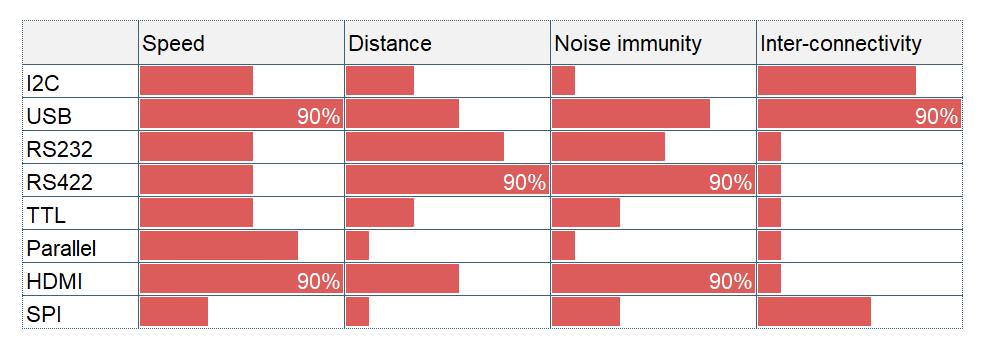
absolute pressure sensors-digital output protocol

Module 05 — Comparison Table

Silicon Piezoresistive vs Ceramic Sensing

The fundamental choice in marine pressure sensing comes down to the sensing principle. Here's why ceramic capacitive wins in seawater environments — across every critical performance dimension.

Feature Silicon Piezoresistive Ceramic Capacitive
Corrosion Resistance ❌ Requires oil-filled isolation diaphragm ✅ Inherently corrosion-proof alumina ceramic
Long-Term Stability ⚠️ Oil degradation, diaphragm fatigue risk ✅ No fill fluid; no drift mechanisms
Temperature Performance ⚠️ Fill fluid expansion causes errors ✅ Superior; less compensation needed
EMI Immunity ⚠️ Susceptible to electrical noise ✅ Capacitive principle naturally noise-resistant
Seawater Track Record ⚠️ Limited; isolation failures common ✅ Proven in offshore O&G, desalination
Cost 💲 Lower initial 💲💲 Higher initial, lower lifecycle
🏆 VERDICT: Ceramic capacitive eliminates the failure modes that make silicon piezoresistive unreliable in seawater.
Module 06 — Pull Quote Block
«It's not the sensing chip that fails — it's what actually touches the seawater.»

— Core principle of marine sensor engineering

Module 07 — Image with Caption

The Silicon Sensor Failure Path

Understanding why silicon piezoresistive sensors fail in marine environments requires examining the complete signal path from seawater to sensing element. Every interface is a potential failure point.

Silicon piezoresistive sensors rely on an oil-filled isolation path — introducing multiple failure points between seawater and the sensing element. Each interface (isolation diaphragm → oil fill → silicon chip) represents a degradation mechanism that accumulates over time in marine service.

Technology Comparison: Silicon Piezoresistive vs. Ceramic Solutions

The evaluation began with understanding the fundamental sensing technologies available for pressure and level measurement.

The two primary technologies considered were silicon piezoresistive and ceramic-based sensors, each with distinct characteristics relevant to seawater applications。

However, before device to use which one, the biggest issue is you need to understand it is not the sensing chip, but what actually touches the seawater.

Silicon piezoresistive: The silicon chip never contacts the seawater.

Advantages

  • Very mature technology
  • High accuracy
  • Widely used

Potential disadvantages

  • Thin metal diaphragm
  • Oil-filled structure
  • Risk (although very low) of oil leakage if the diaphragm is damaged
  • Less tolerant of overload and mechanical shock

Silicon piezoresistive sensors represent mature technology widely used in industrial pressure measurement. These sensors use a silicon diaphragm with diffused or implanted piezoresistive elements that change resistance when the diaphragm flexes under pressure. Silicon piezoresistive sensors offer excellent accuracy, fast response times, and good repeatability. They’re also generally less expensive than ceramic alternatives in basic configurations.

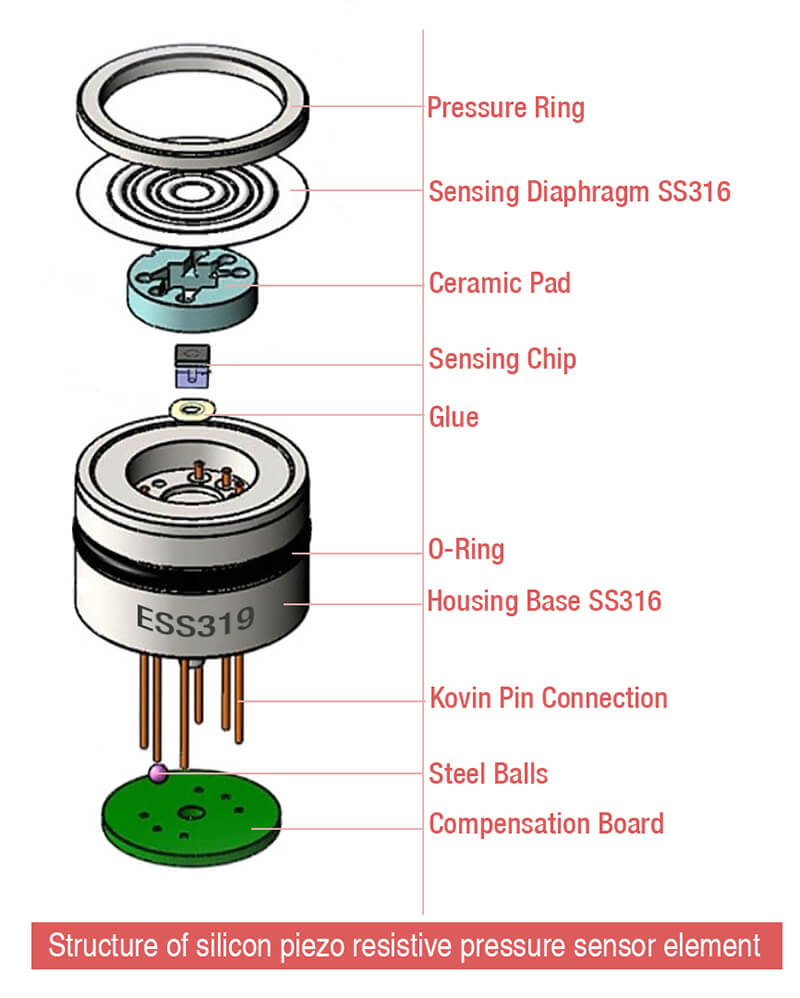
Structure of silicon piezo resistive pressure sensor

However, silicon piezoresistive technology faces significant challenges in seawater applications.

Silicon itself is vulnerable to corrosion in aggressive media, particularly in the presence of chlorides. To protect the silicon sensing element, manufacturers typically use oil-filled isolation systems with a corrosion-resistant diaphragm (often stainless steel or titanium) separating the process medium from the silicon chip. Pressure is transmitted through the fill fluid to the protected sensing element.

This oil-filled isolation approach introduces several potential failure modes. The isolation diaphragm can corrode or fatigue over time, particularly in seawater. The fill fluid can leak, degrade, or develop air bubbles, all of which affect measurement accuracy or cause complete sensor failure. Temperature variations cause the fill fluid to expand and contract, which can introduce measurement errors or stress the isolation system.

For long-term seawater immersion, these vulnerabilities present unacceptable reliability risks.

Ceramic-based sensing technologies avoid these isolation system problems by using inherently corrosion-resistant materials in direct contact with the measured medium. Ceramic sensors use alumina (Al2O3) ceramic diaphragms that are essentially impervious to seawater corrosion. The ceramic material withstands chlorides, other salts, and biological activity without degradation, making it ideally suited for marine environments.

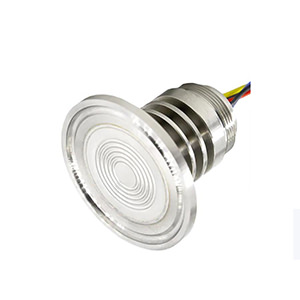
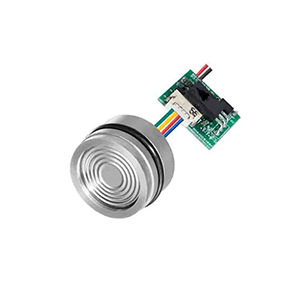
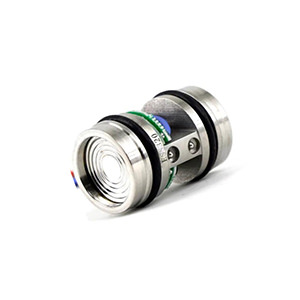
Ceramic Flush Diaphragm Sensor Assembly

Within ceramic sensing technology, two approaches exist: ceramic piezoresistive and ceramic capacitive.

Ceramic piezoresistive sensors use thick-film resistive elements fired directly onto the ceramic diaphragm. When pressure deflects the diaphragm, these resistors change value, producing a measurable signal. This approach combines ceramic’s corrosion resistance with piezoresistive sensing’s proven accuracy and fast response.

Ceramic capacitive sensors, by contrast, measure the capacitance change between the ceramic diaphragm and a fixed electrode as pressure deflects the diaphragm. This technology offers several advantages that proved decisive in my application.

Module 08 — Compare Cards

Ceramic Piezoresistive vs Ceramic Capacitive

Both technologies use ceramic as the wetted material — eliminating the corrosion problem. But they differ fundamentally in how they convert pressure to signal, with significant long-term performance implications.

Ceramic Piezoresistive

  • Faster dynamic response
  • Simpler signal conditioning electronics
  • Lower manufacturing cost
  • Good for dynamic pressure measurement
  • Strain gauges bonded to ceramic surface
  • Some susceptibility to EMI in noisy environments
The decisive factor: long-term stability. Ceramic capacitive has been the go-to for offshore oil & gas, desalination, and marine research — precisely because it delivers reliable measurements through years of continuous seawater exposure. When a sensor must perform for a decade without replacement, the capacitive principle's inherent stability is not a luxury — it's a requirement.
Module 09 — Timeline Steps

Why Endress+Hauser Core Technology

Not all ceramic capacitive elements are equal. The E+H sensing core represents decades of refinement specifically for demanding industrial and marine applications. Here's what sets it apart:

Decades of Ceramic Capacitive R&D

Not a newcomer to the technology. E+H has been refining ceramic capacitive sensing since the 1980s, with continuous improvement cycles driven by real-world offshore and chemical plant feedback.

0.075%–0.1% FS Accuracy as Standard Spec

Not a marketing claim — a verified, documented specification backed by NIST-traceable calibration. Every element ships with individual calibration data, not batch averages.

Global Proven Track Record

Deployed in chemical plants, offshore platforms, and marine installations worldwide. Thousands of installations in active seawater service provide real-world validation that no lab test can replicate.

High-Purity Alumina Ceramic with Precision Metallization

The ceramic composition and electrode metallization are proprietary formulations optimized for long-term stability. Surface finish and geometry are controlled to micron-level tolerances.

Rigorous QC: Every Element Pressure-Cycled and Temperature-Tested

100% individual testing — not sampling. Each element is pressure-cycled across its full range and temperature-tested before shipment. Elements that drift are rejected, not averaged away.

Module 10 — Process Flow

The Eastsensor Integration Model

The key insight: you don't need to buy a complete E+H transmitter to get E+H sensing performance. The integration model separates the premium sensing element from the cost-effective housing and electronics.

1

E+H Sensing Core

2

SS316L Housing Fabrication

3

Marine-Grade Assembly & Sealing

4

Calibration & Factory Testing

The hybrid advantage: By sourcing the E+H sensing core and integrating it into purpose-built marine housings, Eastsensor delivers the accuracy and stability of a tier-one product at 50–70% of the cost. The sensing element — the heart of accuracy and stability — stays premium. The housing, cable, and electronics are produced cost-effectively with full marine-grade specifications.
Module 11 — Checklist Grid

Material Selection Checklist

Every material choice in a marine sensor either contributes to longevity or becomes a failure point. Use this checklist when specifying or evaluating any seawater-rated sensor:

SS316L housing — molybdenum-enhanced for chloride resistance; 2–3% Mo content is non-negotiable for seawater

Viton/fluoroelastomer O-rings — seawater-compatible; EPDM and nitrile degrade rapidly in marine service

Marine-grade PUR cable jacket — UV + abrasion resistant; rated for continuous seawater immersion

Proper surface finish — smooth Ra ≤ 0.8μm = less fouling + corrosion initiation sites

Post-weld passivation — restore chromium oxide layer after welding; citric acid preferred over nitric

No sharp corners or crevices — eliminate corrosion initiation points; all internal radii ≥ 0.5mm

IP68+ cable glands with strain relief — dynamic loading from currents and wave action requires proper strain management

Anti-seize compounds on all threaded connections — galling between SS surfaces is a real risk; use marine-grade anti-seize

Titanium considered for tropical/warm water — cost premium justified in aggressive environments above 25°C or when maintenance access is limited

Module 12 — Cost Cards

Cost-Benefit Snapshot

The hybrid integration model delivers tier-one sensing performance at a fraction of the total cost. Here's the real-world economics:

Tier-One (E+H Full Product)
$1,500 – $3,000
Per unit, complete transmitter
E+H Core + Eastsensor Integration
$600 – $900
Per unit, complete sensor
Savings
50–70%
Without compromising sensing performance
The key insight: The sensing element — the heart of accuracy and stability — stays premium. The housing, cable, and electronics are produced cost-effectively. This is not a compromise — it's intelligent engineering. A $2,500 E+H transmitter and a $750 Eastsensor unit with the same E+H ceramic element will deliver the same measurement quality in the field.
Module 13 — Lessons Learned Cards

Lessons Learned from Marine Deployments

Distilled from real-world deployments across offshore platforms, desalination plants, and coastal monitoring networks:

01
"Technology selection must be driven by environment, not cost alone. The cheapest sensor is always the most expensive when it fails in a remote marine location."
02
"Hybrid approaches — premium sensing core with efficient integration — deliver outstanding value without compromising the measurements that matter."
03
"Verification and documentation are NOT optional — they are essential. An undocumented sensor is an unknown sensor. Traceability is the foundation of measurement confidence."
04
"Installation and maintenance practices determine success more than sensor selection. A premium sensor poorly installed will fail before a mid-range sensor properly deployed."
05
"Digital communication (RS485) pays for itself through remote diagnostics. The ability to interrogate sensor health without a vessel mobilization is worth multiples of the cost difference."
Module 14 — FAQ Accordion

Frequently Asked Questions

Everything you need to know before specifying a seawater level measurement system.

Why can't I use a standard industrial level sensor in seawater?
Chloride corrosion destroys standard housings and diaphragms within months. Standard 304 SS, carbon steel, and most industrial-grade elastomers are not rated for continuous seawater immersion. The combination of chloride concentration, biological activity, and temperature cycling creates a corrosion environment far more aggressive than typical industrial service.
What makes ceramic capacitive better than piezoresistive for seawater?
No oil fill, no thin metal diaphragm, superior long-term stability. Silicon piezoresistive sensors require an oil-filled isolation system to protect the silicon chip from corrosive media — this oil degrades over time, the isolation diaphragm fatigues, and the result is measurement drift and eventual failure. Ceramic capacitive sensors have no fill fluid and no thin metal diaphragm — the ceramic itself is the wetted surface, and alumina ceramic is essentially inert in seawater.
Why choose Endress+Hauser as the sensing core?
Proven 0.075%–0.1% FS accuracy; decades of offshore and marine track record. E+H ceramic capacitive elements have been deployed in some of the harshest industrial environments on earth — North Sea offshore platforms, Middle Eastern desalination plants, chemical processing facilities. This real-world validation, combined with rigorous individual element testing and full calibration documentation, makes E+H the benchmark for ceramic capacitive sensing.
Is SS316L really enough for seawater applications?
Yes, for moderate temperatures and regular maintenance — 10+ year service life is achievable. SS316L's molybdenum content (2–3%) provides significantly better chloride resistance than 304 SS. With proper surface finish, post-weld passivation, and annual maintenance, SS316L sensors routinely achieve 10+ year service lives in coastal and offshore applications.
When should I upgrade to titanium housing?
Warm tropical waters (above 25°C) or when maintenance access is extremely limited. Chloride corrosion rates increase significantly with temperature. In tropical coastal waters, warm desalination plant environments, or any installation where annual maintenance is not feasible, titanium's superior corrosion resistance justifies the cost premium.
Why RS485 instead of 4–20mA for marine installations?
Digital multi-variable data, remote diagnostics, and 1200m reach. The 200m cable runs typical in offshore applications approach the practical limit of 4–20mA reliability. RS485 handles 1200m with margin. More importantly, the ability to read diagnostic registers remotely — without a vessel mobilization — transforms maintenance from reactive to proactive.
What is Modbus RTU and why use it?
Open industrial protocol; works with any PLC/SCADA system. Modbus RTU is the most widely supported industrial communication protocol — virtually every PLC, data logger, SCADA system, and industrial computer supports it natively. Unlike proprietary protocols, Modbus RTU ensures you're never locked into a single vendor's ecosystem.
How do I verify the E+H core is genuine?
Require purchase documentation, serial number traceability, and certification. Every genuine E+H sensing element has a unique serial number that can be traced to calibration records. Request the original E+H purchase documentation and individual calibration certificate. The serial number should be physically marked on the element and match the documentation.
How often does the sensor need cleaning?
Quarterly to annually, depending on local biofouling rates. Tropical warm waters with high nutrient loads may require quarterly cleaning — barnacle settlement can begin within weeks. Cold, nutrient-poor waters may allow annual service intervals. The RS485 diagnostic data provides early warning: increasing zero drift or signal noise often precedes visible fouling.
What's the total cost of ownership?
$600–900 initial, plus annual cleaning/calibration — far less than failed-sensor replacement costs. The TCO calculation must include: initial sensor cost, installation labor, annual maintenance, and the probability-weighted cost of failure. When these factors are properly accounted for, the ceramic capacitive sensor with E+H core consistently delivers the lowest 10-year TCO.
Module 15 — CTA Call-to-Action
Ready to Deploy

Ready to Deploy Reliable Seawater
Level Measurement?

Get a custom configuration based on ceramic capacitive sensing with E+H core, tailored to your installation requirements — depth range, cable length, housing material, and output protocol.

📧 [email protected]  |  📞 +86-136-2929-7491

🔒 E+H Certified Core
📋 Full Calibration Certificate
✅ Factory Acceptance Tested
Module 16 — Related Posts Grid