Constant Voltage vs Constant Current – Which One Do You Really Need?
If you’re an engineer selecting pressure sensors or a procurement manager comparing specifications, you’ve probably encountered two terms: constant voltage drive and constant current drive.
We’ve noticed this question comes up repeatedly, these aren’t just technical jargon—they directly impact measurement accuracy, temperature stability, and overall system cost.
What’s the Real Difference?
Both methods power piezoresistive pressure sensors, but they work fundamentally differently:
Constant Voltage Drive applies a fixed voltage (typically 5V DC, 10VDC) across the sensor’s Wheatstone bridge. When pressure changes, the bridge resistance changes, producing a proportional voltage output.
Constant Current Drive injects a fixed current (typically 1mA or 1.5mA) through the bridge. As pressure alters the resistance, the voltage across the bridge changes according to Ohm’s law.
The math looks simply, but the real-world implications are significant.
Quick Comparison Table between Constant Voltage vs Constant Current
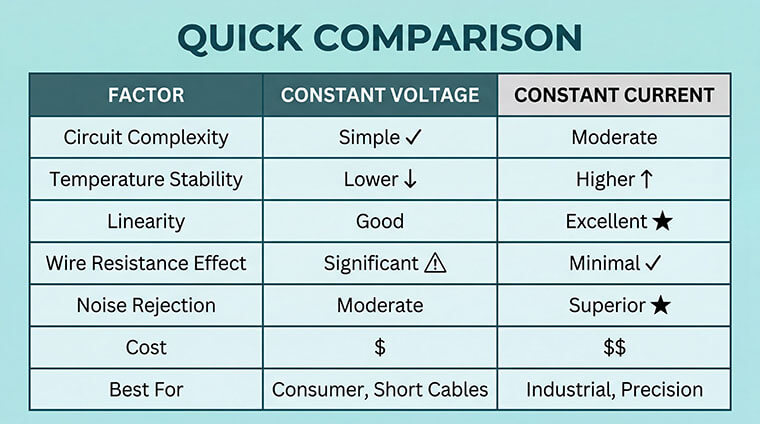
Factor Constant Voltage Constant Current
Circuit complexity Simple (just a voltage regulator) Moderate (requires current source circuit)
Temperature stability Lower (sensitivity drops with temperature) Higher (built-in compensation)
Linearity Good (but slightly nonlinear at extremes) Excellent (direct ΔR-to-voltage conversion)
Lead wire resistance effect Significant (voltage drop in long cables) Minimal (current maintained regardless)
Power supply noise rejection Moderate Superior
Typical cost Lower Higher
Best for Consumer electronics, automotive oil pressure, budget-conscious projects Industrial transmitters, wide temperature ranges, high-precision instrumentation
The Temperature Problem Nobody Talks About
Here’s where theory meets reality. Most piezoresistive sensors use silicon or metal film resistors with positive temperature coefficients—meaning resistance increases as temperature rises.
What Happens with Constant Voltage?
When temperature climbs, bridge resistance goes up. Since voltage stays fixed, current through the bridge drops. Lower current means lower sensitivity. Without complex compensation circuits, you’ll see significant drift across temperature ranges.
Real-world example: A sensor operating from 0°C to 80°C might show 15-20% sensitivity variation with constant voltage drive. That’s huge if you’re measuring anything critical.
What Happens with Constant Current?
When temperature rises and resistance increases, the voltage across the bridge naturally increases too (since current is held constant). This creates an automatic compensation effect that substantially reduces temperature-induced errors.
The same sensor with constant current drive might show only 3-5% variation across the same temperature range—without any external compensation.
Linearity: Why It Matters for Calibration
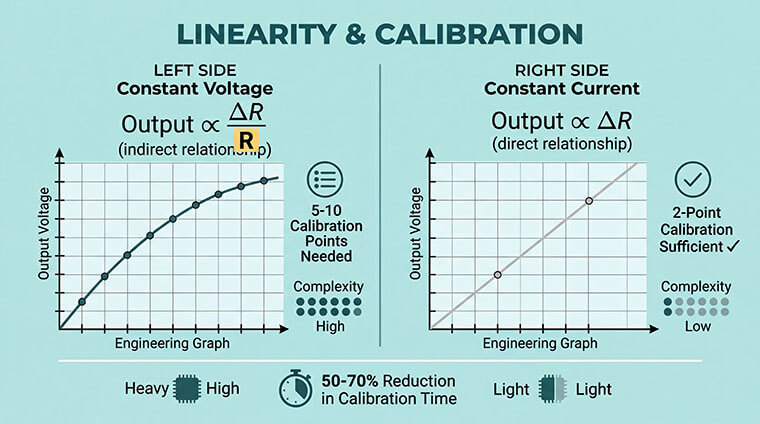
Constant voltage output is proportional to ΔR/R. Notice that R appears in the denominator? That introduces nonlinearity, especially at higher pressure ranges. Not a dealbreaker, but it means more calibration points and potentially more complex curve-fitting in your software.
Constant current output is proportional to ΔR directly. For most piezoresistive sensors, resistance change is highly linear with applied pressure. This direct relationship means you often get away with simple two-point calibration, saving development time and reducing computational load in embedded systems.
Lead Wire Resistance: The Hidden Enemy
If your sensor sits more than a few meters from your electronics, lead wire resistance becomes a real issue.
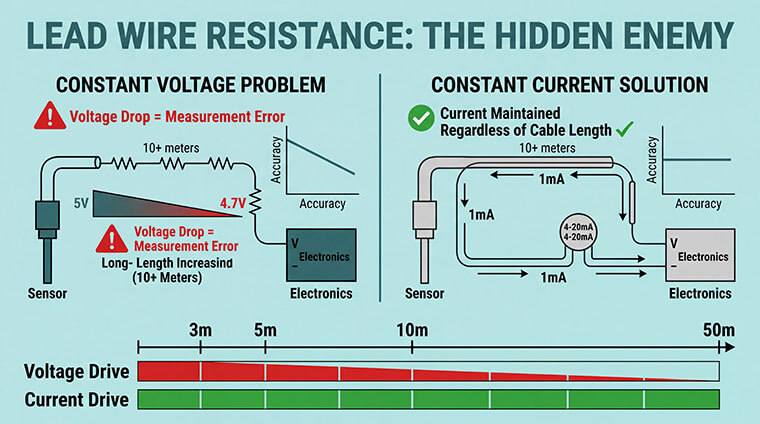
With constant voltage drive, the resistance of your cable directly reduces the voltage reaching the sensor. A few ohms of wire resistance can throw off your readings by several percentage points. You’ll need thicker wire or compensated circuits.
With constant current drive, wire resistance barely matters. Current stays constant regardless of total loop resistance (within reasonable limits). This is why industrial 4-20mA transmitters dominate factory floors—they’re immune to cable length issues.
Power Supply Noise and Stability Requirements
Constant voltage systems are sensitive to supply voltage fluctuations. A 100mV ripple on a 5V supply translates directly to measurement error. You need clean, stable voltage regulation.
Constant current systems naturally reject power supply noise. Even if supply voltage varies by several hundred millivolts, the current regulation circuit maintains stable excitation. This makes constant current drive more robust in electrically noisy industrial environments.
Real-World Application Guide
- You’re building prototypes or low-volume projects
- Operating temperature range is narrow (±20°C from room temperature)
- Cable runs are short (under 3 meters)
- Cost is the primary constraint
- You have clean, regulated power available
- Application examples: Consumer appliances, automotive cabin pressure monitoring, weather stations, hobby projects
- Temperature range exceeds 50°C span
- You need better than 0.5% accuracy
- Cable runs exceed 10 meters
- Operating in electrically noisy environments (motors, switching supplies nearby)
- Long-term stability is critical
- Application examples: Industrial process control, hydraulic systems, aerospace instrumentation, medical
Implementation Complexity
Constant voltage is straightforward—you can use an off-the-shelf voltage regulator IC.
- Total parts count: 2-3 components.
- Implementation time: minutes.
Constant current requires more careful design. You need either a dedicated current source IC, an op-amp circuit with precision resistors, or a microcontroller with DAC and feedback control.
- Parts count: 5-10 components.
- Implementation time: hours to days, depending on your experience.
However, the upfront complexity often pays off in reduced calibration time, better field performance, and fewer customer complaints about drift.
Cost-Benefit Reality Check
Let’s be honest about costs:
- Constant voltage systems might save you $2-5 per unit in component costs
- Constant current systems add that $2-5 but potentially save you:
For high-volume consumer products, constant voltage makes sense. For anything industrial or safety-critical, constant current quickly becomes the more economical choice.
What About Hybrid Approaches?
Some modern sensor conditioning ICs offer programmable excitation modes. You can start with constant voltage for initial testing, then switch to constant current for production. This flexibility is valuable during product development when requirements might shift.
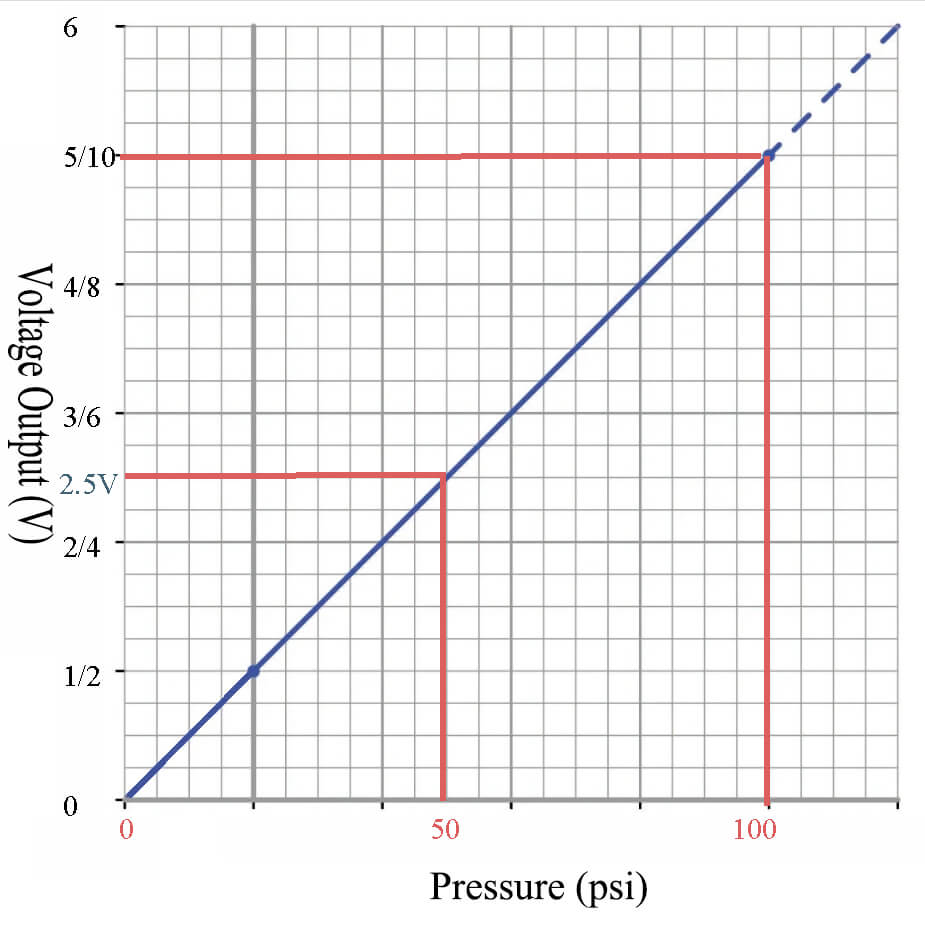
Additionally, some high-end systems use ratiometric measurement with constant voltage, where the output is measured as a ratio to the excitation voltage (for example: 0.5-4.5V output pressure sensor). This partially compensates for voltage variations but doesn’t solve the temperature sensitivity issue.
Making the Decision: Three Questions to Ask
Before choosing, answer these:
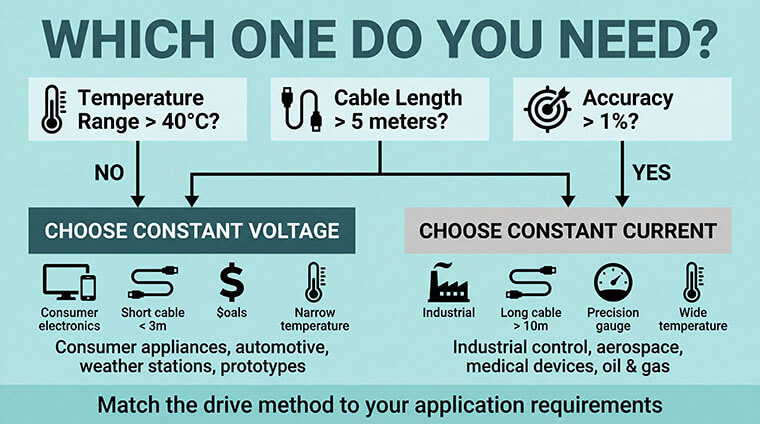
- What’s my operating temperature range? If it’s wider than 40°C, lean toward constant current.
- How long are my cables? Beyond 5 meters, constant current becomes significantly easier to implement reliably.
- What’s my accuracy requirement? If you need better than 1% full-scale accuracy, constant current is almost always worth it.
Common Misconceptions Cleared Up
MYTH: “Constant current is always better.”
REALITY: For narrow temperature ranges and short cables, constant voltage is perfectly adequate and more cost-effective.
MYTH: “You can’t use constant voltage in industrial applications.”
REALITY: Many industrial sensors use constant voltage with good temperature compensation circuits. It’s about matching the drive method to your specific requirements.
MYTH: “Constant current eliminates all temperature effects.”
REALITY: It significantly reduces them, but doesn’t eliminate them entirely. Some temperature drift remains, just much less than with constant voltage.
FAQ: Constant Voltage vs Constant Current
Can I switch between voltage and current drive with the same sensor?
Yes, most piezoresistive sensors work with both methods. However, output characteristics and accuracy will differ significantly. Check your sensor’s datasheet for recommended excitation specifications and output ranges.
Why does my sensor drift more in summer months?
Likely using constant voltage drive without temperature compensation. Resistance increases with heat, reducing sensitivity. Consider switching to constant current drive or adding temperature compensation circuits for seasonal stability.
Will longer cables affect my pressure readings?
With constant voltage, yes—cable resistance reduces sensor excitation. With constant current, minimal impact up to 50+ meters. For cables over 10 meters, constant current drive is strongly recommended.
Do I need special components for constant current drive?
Not necessarily. Simple circuits use precision resistors and op-amps. Dedicated current source ICs simplify design. Many modern sensor conditioning chips include programmable constant current modes built-in.
Which method gives faster response time?
Both offer identical dynamic response—it’s determined by sensor mechanics, not drive method. The difference is in accuracy and stability, not speed. Response time depends on sensor diaphragm design.
Can constant current drive reduce my calibration costs?
Yes, significantly. Better linearity means fewer calibration points needed—often just two-point instead of five-point calibration. This cuts calibration time by 50-70% in production, reducing per-unit costs substantially.
Conclusion
There’s no universal “best” choice—constant voltage and constant current each shine in different scenarios. The key is matching the drive method to your application requirements, considering temperature range, accuracy needs, cable length, and cost constraints.
For most industrial and precision applications, constant current’s superior temperature stability and linearity justify the slightly higher complexity. For cost-sensitive consumer applications with controlled environments, constant voltage remains perfectly viable.
Still uncertain which approach fits your application? Our technical team reviews hundreds of sensor applications each year. Reach out with your specifications, and we’ll provide personalized recommendations—usually within 24 hours.