
Introduction
When you’re designing aerospace test equipment, medical devices, or performance engines, every millimeter counts. When installation space is tight and you also need accurate pressure data, there’s barely room for a standard pressure sensor and a standard transmitter because may be too large.
A low-cost alternative may fit, but fail when the signal changes quickly. And if the output does not match your system, the “cheap” option can become expensive once rework, delays, and redesign start piling up.
That is why many engineers and sourcing teams look specifically for a miniature pressure transducer: something compact enough to fit, accurate enough to trust, and flexible enough to integrate without turning the whole project into a custom headache.
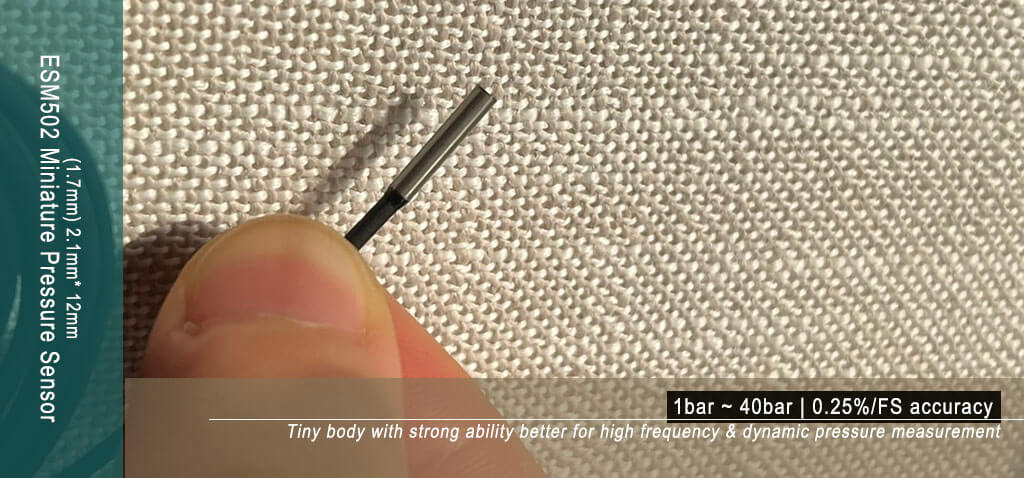
Miniature pressure transducer: What Makes it and What You Should Care About?
Here’s the reality: there’s no industry-standard definition.
Some manufacturers call anything under 15mm diameter “miniature.” Others use the term for sensors under 10mm.
The practical definition depends on your application.
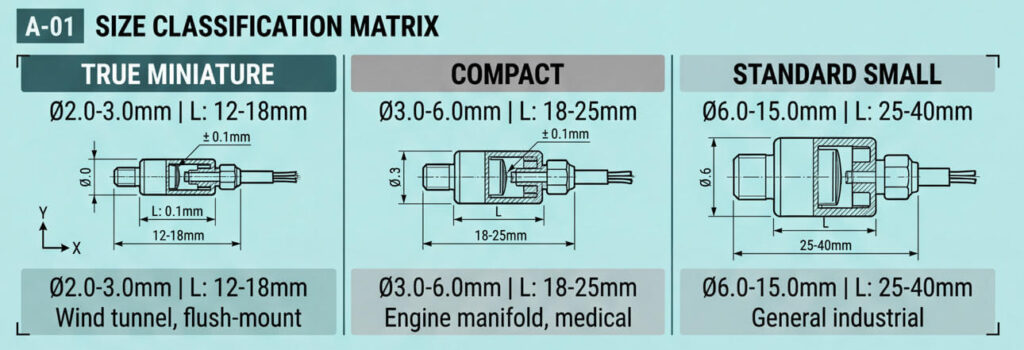
- For wind tunnel testing, you might need a 3mm diameter probe that can mount flush with a model surface.
- For an engine intake manifold, you need something small enough to thread into existing ports without restricting airflow.
Real miniature pressure transducers typically range from 2-6mm in diameter and 10-25mm in length. Anything larger is just a compact sensor, not truly miniature.
The Technology Behind Modern Miniature Pressure Sensors
Most quality miniature transducers today use MEMS (Micro-Electro-Mechanical Systems) technology. But not all MEMS sensors are created equal.
Silicon-on-Silicon vs. Other MEMS Approaches
Silicon-on-silicon bonding technology represents the current state-of-the-art.
The sensing diaphragm and base are both precision-etched silicon, bonded at the molecular level. This creates exceptional stability because both materials expand and contract identically with temperature changes. You get better long-term drift characteristics and higher accuracy compared to older technologies that bond silicon to glass or metal.

For critical applications, this translates to pressure measurements you can trust without constant recalibration.
Key Specifications That Actually Matter
Engineers always don’t want to waste hours comparing spec sheets. Alright, here’s what may deserve your attention:
The Starting Point of Miniature Pressure Transducer
Dimension Typical Range Your Consideration
Diameter 2.1mm - 6mm What's the smallest opening or mounting space?
Length 12mm - 30mm How deep can the sensor penetrate?
Thread Size M3 to M5 common Does it match existing ports?
Cable Diameter 1-2mm Can cables route through your assembly?
Pro tip from the field: Always account for cable bend radius. A 2.5mm sensor is useless if its 2mm cable needs 2.5mm of routing space you don’t have.
Accuracy: Understanding What 0.25% Really Means
You’ll see accuracy specs like “±0.25% FS” (Full Scale). This means across your pressure range, readings could vary by 0.25% of the maximum pressure.
Example:
For a 0-100 PSI transducer with 0.25% accuracy:
- Maximum error: ±0.25 PSI across the entire range
- At 10 PSI actual pressure: ±2.5% relative error
- At 100 PSI actual pressure: ±0.25% relative error
What this means for you: High accuracy matters most when you need precision at lower pressures within your range. For many applications, 0.25-0.5% accuracy hits the sweet spot between performance and cost.
Output Signal Options of Miniature Pressure Transducer
Signal Type Advantages Best For
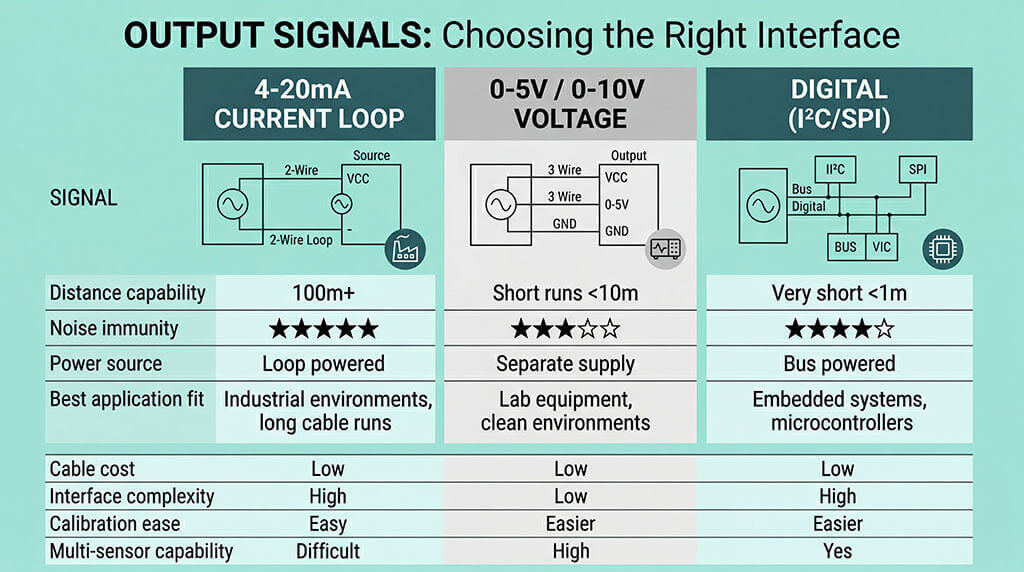
4-20mA Excellent noise immunity, long cable runs (100m+) Industrial environments, remote mounting
0-5V / 0-10V Simple interface, lower power Short cable runs, clean environments, battery operation
Amplified mV Highest resolution Lab environments, dedicated instrumentation
Digital (I²C, SPI) Direct microcontroller interface Embedded systems, IoT applications
Current loop (4-20mA) outputs dominate industrial applications for good reason—the signal doesn’t degrade over distance, and you can detect sensor failures (a broken wire reads 0mA, clearly wrong).
Voltage outputs work great for short cable runs and are easier to interface with standard data acquisition cards.
Relating post for your reference:
- Analog Output Pressure sensor
- Voltage Output Pressure Sensor
- Millivolt Output Pressure Sensor
- 4-20mA Pressure Sensor
- Digital Pressure Sensor
Ready to solve your space-constrained pressure measurement challenge?
Our engineering team specializes in custom miniature pressure measurement solutions.
Critical Applications Where Size and Performance Both Matter
Wind Tunnel Testing: The Ultimate Challenge
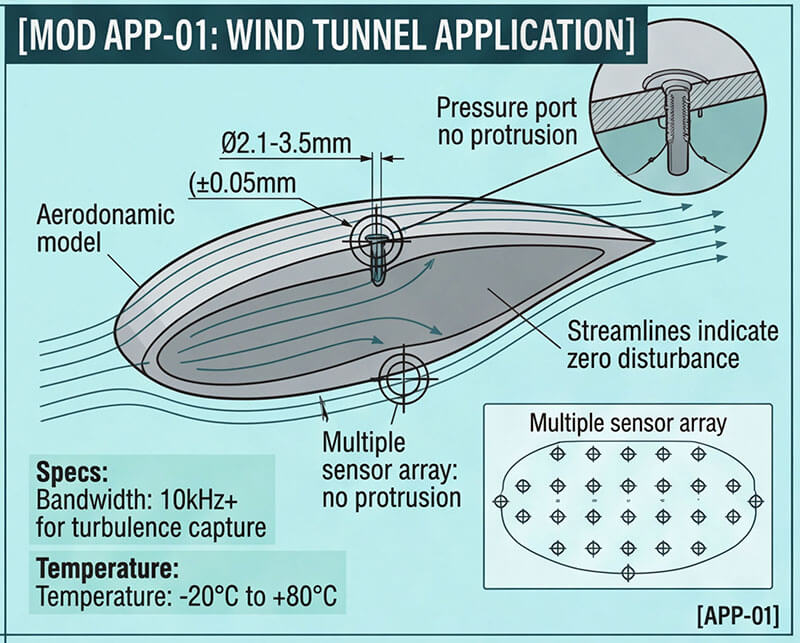
Wind tunnel models demand sensors that won’t disturb airflow. Even a 1mm protrusion can create turbulence that invalidates your data.
What engineers need:
- Flush-mounting capabilities (2.1-3.5mm diameter range)
- High-frequency response for capturing turbulent fluctuations (10kHz+ bandwidth)
- Minimal thermal drift (temperature changes rapidly during test runs)
- Multiple sensors per model (cost and size both matter)
Silicon-on-silicon MEMS technology excels here because the small diaphragm size naturally provides fast response times. You can capture pressure fluctuations that older, larger sensors simply miss.
Engine Intake Manifold Pressure Monitoring
Whether you’re tuning race engines or validating production powertrains, you need accurate pressure data from locations with zero extra space.
Key requirements:
- Small enough to thread into existing ports without flow restriction
- Survive high temperatures (intake air can exceed 120°C)
- Handle vibration without drift or failure
- Dynamic response to capture pressure pulses from valve events
THE REALITY: Standard sensors often require manifold modifications. True miniature transducers install in existing M5 threaded bungs originally meant for temperature sensors.
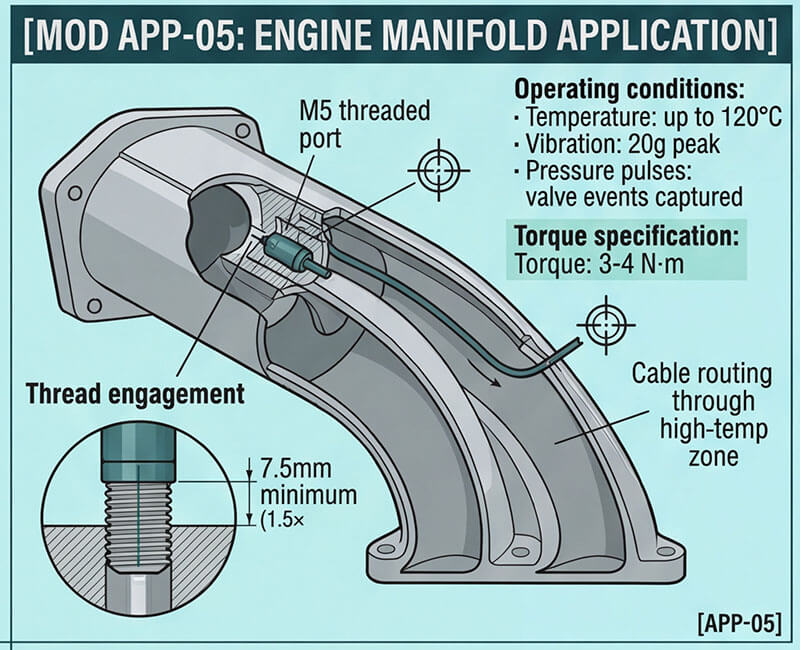
Medical Device Integration
From respiratory equipment to drug delivery systems, medical applications demand miniature sensors that meet strict size, accuracy, and reliability requirements.
Critical factors:
- Biocompatible materials for patient contact
- Sterilization compatibility (autoclave, gamma, EtO)
- Low power consumption for battery operation
- Compact size for patient comfort
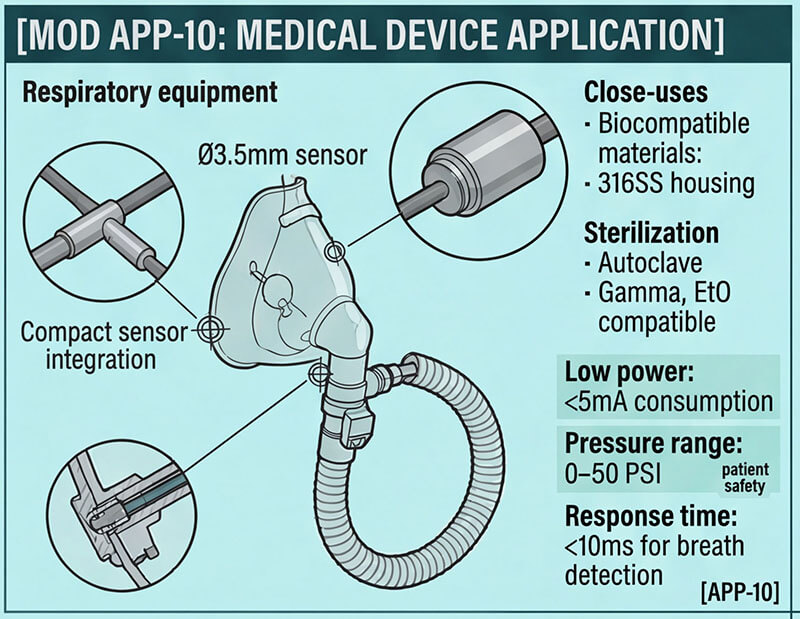
Hydraulic System Monitoring in Tight Spaces
Mobile hydraulics, aerospace actuation systems, and robotic applications increasingly require pressure monitoring at points where standard sensors simply don’t fit.
Engineering challenges:
- Vibration resistance in mobile equipment
- Pressure spike tolerance
- Compact installation in valve bodies or actuator housings
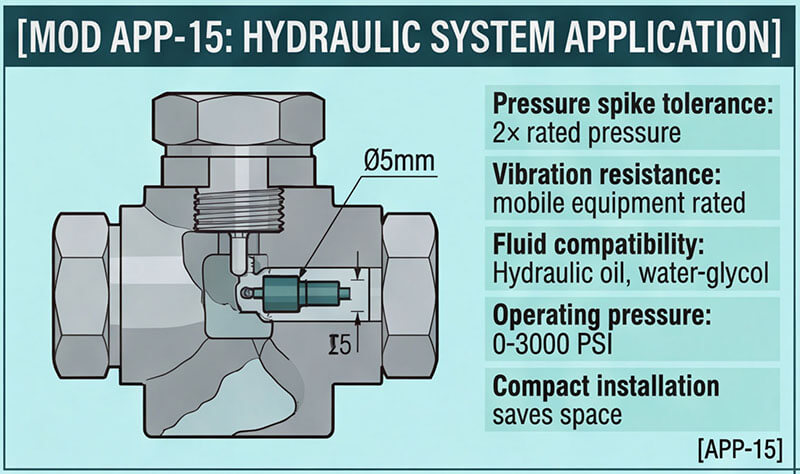
How to Select the Right Miniature Pressure Transducer
Based on hundreds of application consultations, here’s the systematic approach that works and may be helpful for your decision make.
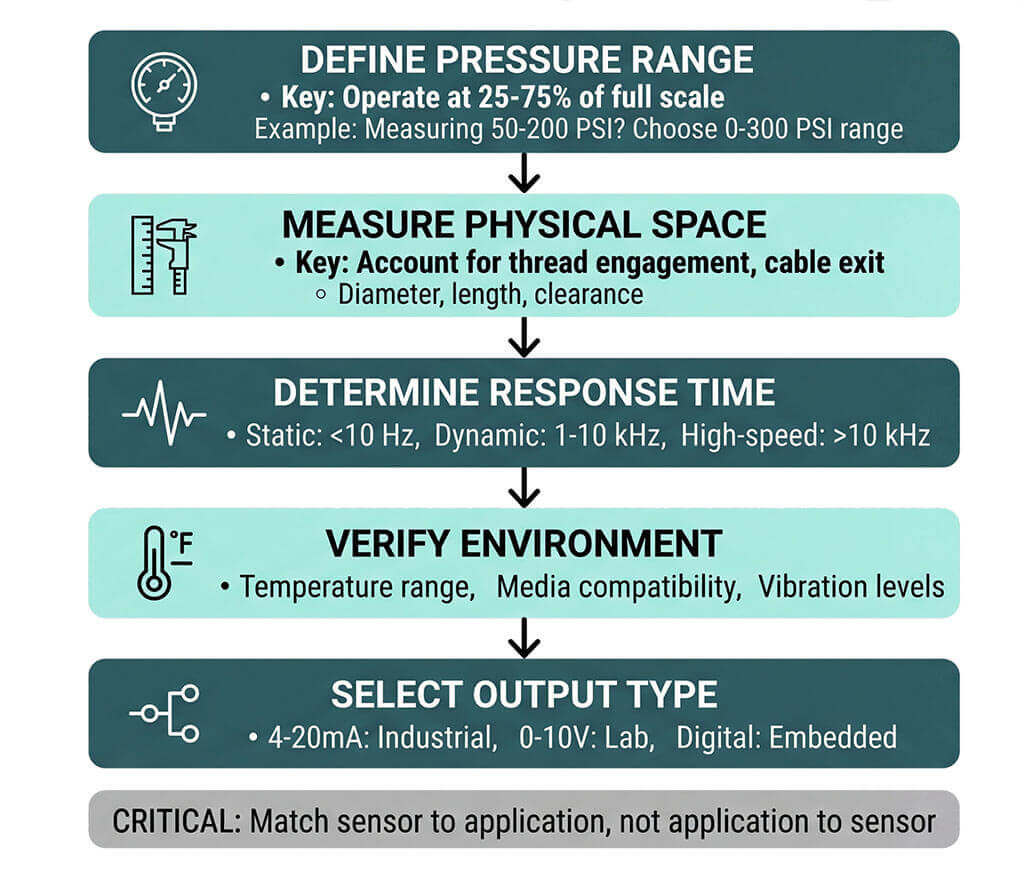
STEP 1: Define Your Pressure Range
Choose a range that puts your typical operating pressure between 25-75% of full scale. This maximizes accuracy where you actually operate while providing headroom for transients.
COMMON MISTAKE: Specifying a 1000 PSI sensor when you’re measuring 50-200 PSI. Your effective resolution and accuracy suffer dramatically.
STEP 2: Identify Physical Constraints
Measure your available space exactly. Account for:
- Mounting thread engagement depth
- Cable exit clearance
- Electrical connector space (if applicable)
- Maintenance access requirements
STEP 3: Determine Response Time Requirements
Relating post for your reference:
- Pressure Range: How to choose it for pressure sensor
- Overpressure, Proof pressure, Burst pressure
- Pressure Sensor Range and Accuracy
Application Type Required Response Typical Bandwidth
Static/Slow Changing Seconds <10 Hz
Process Control 100-500ms 10-50 Hz
Dynamic/Pulsing <10ms 1-10 kHz
High-Speed Transients <1ms >10 kHz
MEMS-based miniature sensors naturally provide excellent frequency response due to their small, lightweight diaphragms.
STEP 4: Environmental Conditions
Be honest about operating conditions:
- Temperature range (ambient and media)
- Pressure medium (air, water, oil, corrosive gases)
- Vibration and shock levels
- Electrical noise environment
STEP 5: Output and Interface
Match your data acquisition system. If you’re using a PLC, 4-20mA is standard. If you’re logging with a microcontroller, consider digital output options. For traditional DAQ cards, 0-10V often works best.
Not sure which specifications matter most for your application?
Our technical team reviews hundreds of installations annually.
Customization: When Standard Options Don’t Fit
Here’s something most engineers don’t realize until they’re deep into a project:
MINIATURE PRESSURE TRANSDUCERS ARE HIGHLY CUSTOMIZABLE
Standard catalog products work for common applications, but when you’re solving a unique challenge, customization often provides better performance at competitive costs.
Common Customization Options
Physical modifications:
- Custom cable lengths and types (Teflon, silicone, armored)
- Special mounting threads or hex flats
- Extended or shortened body lengths
- Custom electrical connectors
Performance specifications:
- Optimized pressure ranges for your exact application
- Enhanced temperature compensation
- Special output scaling (e.g., 1-5V instead of 0-5V)
- Multiple pressure ranges with the same physical package
Material selections:
- Wetted materials for chemical compatibility
- Special housing materials for harsh environments
- Alternative diaphragm materials for specific media
When Customization Makes Sense
You should consider custom specifications when:
- Mounting space is extremely limited or has unusual geometry
- Standard pressure ranges don’t align with your operating conditions
- Environmental conditions exceed standard ratings
- You need multiple sensors with identical characteristics
- Your application requires specific certifications
Real example:
An aerospace customer needed pressure sensors for a UAV wing. Standard sensors were too heavy. We reduced the housing length by 6mm and switched to a lighter cable construction, saving 8 grams per sensor. Across 24 measurement points, that’s nearly 200 grams—significant for flight performance.
Quality Factors That Separate Reliable Sensors from Problems
After supporting customers through countless installations, certain quality indicators consistently predict long-term success:
Manufacturing Process Indicators
Silicon-on-silicon bonding quality: Look for manufacturers who can demonstrate stable drift characteristics over temperature cycles. Poor bonding creates micro-gaps that cause measurement drift.
Calibration procedures: Quality manufacturers perform multi-point calibration across temperature ranges, not just room temperature calibration. Ask about their calibration process.
Testing protocols: Beyond basic functionality, reliable sensors undergo:
- Temperature cycling
- Pressure cycling (millions of cycles for dynamic applications)
- Vibration and shock testing
- Long-term drift characterization
Material Selection
The wetted materials (parts touching your measured media) determine compatibility and longevity. For MEMS silicon sensors:
- Silicon diaphragm handles most gases and many liquids
- Stainless steel housings provide broad chemical compatibility
- Special coatings enable use with corrosive media
Don’t assume compatibility—verify that wetted materials suit your specific media and operating conditions.
Installation Best Practices for Miniature Sensors
Size doesn’t eliminate installation requirements. Small mistakes cause big problems:
Mounting Considerations
Thread engagement: Ensure adequate thread engagement (typically 1.5× thread diameter minimum). Miniature sensors need proper mounting torque for seal integrity and thermal coupling.
Pressure port design: The connection to your pressure source matters enormously:
- Avoid long, small-diameter passages (they create pressure lag)
- Minimize volume between sensor and measurement point
- Remove burrs and debris that could block the pressure port
Thermal management: The sensor body needs thermal stability for accurate measurement. Allow time for temperature equilibrium, especially after power-on.
Electrical Connections
Cable strain relief: Miniature sensors have delicate cables. Always provide strain relief at the sensor connection point. A slight cable pull shouldn’t translate to force on the sensor.
Electrical noise: Use shielded cables in electrically noisy environments. Ground shields properly—at one end only for voltage outputs (avoid ground loops).
Power supply: Provide clean, regulated power. Noisy supplies directly affect measurement quality, especially with voltage outputs.
Pressure Medium Considerations
Filtering: If your media contains particles, install filtering upstream. A tiny particle can block the pressure port of a miniature sensor.
Condensation: In pneumatic applications where temperature varies, condensation can occur inside pressure passages. Design your system to drain condensate away from sensors.
Pressure pulsations: Severe pressure spikes can damage sensors over time. If your application generates pressure hammering, consider pulse dampeners or specify sensors rated for higher overpressure.
Installing miniature sensors in a critical application?
We provide detailed installation guidelines and technical support for every project.
Troubleshooting Common Issues
Unstable Readings
Possible causes:
- Inadequate warm-up time (allow 15-30 minutes for thermal stabilization)
- Loose mounting (check installation torque)
- Electrical noise pickup (verify cable shielding and grounding)
- Pressure medium fluctuations (are you measuring process instability, not sensor issues?)
Accuracy Drift Over Time
Investigation steps:
- Check if drift is temperature-related (measure sensor body temperature)
- Verify media compatibility (has anything changed in your process?)
- Assess mechanical stress (over-torqued installation can cause drift)
- Consider pressure cycling fatigue (has the sensor experienced specification limits?)
Signal Issues
4-20mA outputs: Verify loop power supply and measure loop resistance. Standard 4-20mA loops require 7-30VDC supply and work with up to 500-750Ω total loop resistance (depending on supply voltage).
Voltage outputs: Check for ground loops if you see noise. Measure supply voltage at the sensor, not just at the power supply.
Cost Considerations: Making the Business Case
Miniature pressure transducers typically cost more than standard sensors of similar pressure range. Here’s why—and when the premium is justified:
Cost drivers:
- Specialized manufacturing processes
- Lower production volumes
- More complex calibration requirements
- Custom cable and connection solutions
When miniature sensors save money overall:
- Avoiding system redesigns to accommodate larger sensors
- Eliminating custom mounting adapters and fixtures
- Enabling measurement at points previously considered inaccessible
- Reducing installation labor (smaller, easier to route)
- Preventing measurement errors from pressure lag in long connection tubes
Hidden costs of choosing standard sensors for tight spaces:
- Redesign and remanufacturing of housings or manifolds
- Pressure connection tubing that adds lag and dampens dynamic response
- Compromised measurement accuracy from non-ideal mounting
- Maintenance access problems requiring disassembly for sensor service
Making Your Decision: A Final Checklist
Before specifying your miniature pressure transducer:
Technical requirements:
- Pressure range matches operating conditions (25-75% of full scale typical)
- Physical size confirmed with actual measurements, not estimates
- Accuracy specification appropriate for application needs
- Output signal compatible with data acquisition system
- Temperature rating exceeds operating conditions by comfortable margin
- Frequency response adequate for dynamic requirements (if applicable)
Application compatibility:
- Wetted materials compatible with pressure medium
- Mounting configuration suits installation location
- Cable length and type appropriate for routing
- Environmental ratings (IP rating, vibration resistance) confirmed
Practical considerations:
- Lead time acceptable for project schedule
- Customization options explored if standard doesn’t quite fit
- Installation support and documentation available
- Calibration and maintenance procedures understood
OUR QUICK SELECTION GUIDE
If your project looks like this, our miniature pressure transducer may be a strong fit:
| Your requirement | Fit |
|---|---|
| Very limited installation space | Yes |
| Dynamic or high-frequency pressure signal | Yes |
| Need amplified analog output | Yes |
| Need compact package for OEM integration | Yes |
| Need customization | Yes |
| Need a general-purpose large-body transmitter | Probably not the best choice |
Partner With Experts in Miniature Pressure Measurement
For fifteen years, we’ve specialized in solving challenging pressure measurement problems where space is limited but accuracy can’t be compromised.
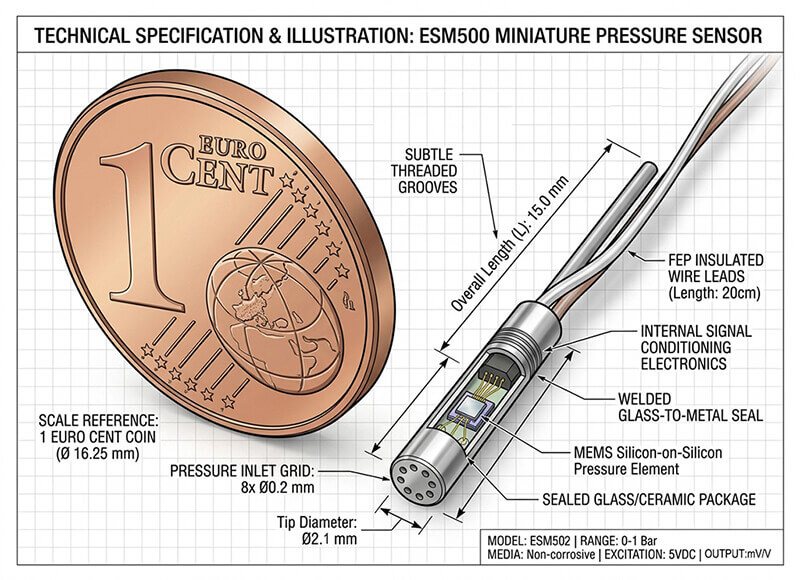
Our silicon-on-silicon MEMS technology provides measurement precision in packages from 2.1mm diameter, like ESM502 genuinely miniature sensors for high-frequency, dynamic, and space-limited applications, the accuracy up to 0.25%, and amplified output options including 4–20 mA, 0–5 V, and 0–10 V, 2-6 weeks lead time vary from regular type to customized model, these transducers are designed to help customers solve real integration problems, not just fill a line in a datasheet.
Why Engineers Choose Our Miniature Pressure Transducers
Proven technology foundation:
- Silicon-on-silicon MEMS sensing for exceptional stability
- 0.25% accuracy maintained across operating temperature range
- High-frequency response for capturing dynamic pressure events
- Sizes from 2.1mm to 3.5mm diameter, 12-18mm length
Flexible output options:
- 4-20mA current loop for industrial environments
- 0-5V and 0-10V voltage outputs for standard DAQ
- Custom output configurations available
Application-focused engineering:
- Wind tunnel testing solutions with minimal flow disturbance
- Engine manifold sensors for performance optimization
- Hydraulic system monitoring in mobile equipment
- Custom solutions for unique space-constrained applications
Manufacturing capabilities that matter:
- In-house R&D for rapid custom development
- Production facilities enabling volume manufacturing
- Quality systems ensuring consistent sensor performance
- Technical support throughout specification, installation, and operation
Get Started With Your Miniature Pressure Solution
For Application Engineering Support:
Share your technical requirements, space constraints, and operating conditions. Our engineering team will recommend optimal sensor specifications and identify any customization that could improve performance or reduce total system cost.
For Sourcing and Procurement:
Receive detailed specifications, pricing, lead times, and volume discount structures. We work with your purchasing requirements for samples, prototype quantities, or production volumes.
For Custom Development:
Discuss your unique requirements with our R&D team. We develop custom miniature pressure solutions for applications where standard products don’t meet your needs.
Document your requirements and reach out today.
Whether you need a single prototype sensor for concept validation or thousands of units for production, we provide the miniature pressure measurement solutions that fit your application—literally and figuratively.
FAQ: Miniature Pressure Transducer
1. What diameter qualifies as "miniature" for pressure transducers?
True miniature transducers range from 2-6mm diameter. Anything under 3.5mm is exceptionally compact. Beware marketing claims—verify actual dimensions including cable diameter and mounting requirements for your space.
2. Why are miniature pressure transducers more expensive than standard sensors?
Specialized MEMS fabrication, lower production volumes, complex miniaturization engineering, and precision calibration drive costs higher. However, they often eliminate expensive system redesigns, custom mounting fixtures, and measurement compromises.
3. Can miniature sensors handle high pressures despite their small size?
Absolutely. MEMS silicon diaphragms are incredibly strong relative to size. Miniature sensors routinely handle 5,000+ PSI. Pressure capacity depends on diaphragm design and materials, not overall sensor size.
4. How does accuracy compare between miniature and standard-sized pressure transducers?
Quality miniature MEMS sensors achieve 0.25-0.5% accuracy—matching or exceeding standard sensors. Silicon-on-silicon technology provides exceptional stability. Size doesn’t compromise accuracy when proper manufacturing processes are used.
5. What's the frequency response of miniature pressure sensors for dynamic measurements?
Miniature MEMS sensors excel at high-frequency response—often 10kHz+ bandwidth. Small, lightweight diaphragms react faster than larger sensors. Ideal for capturing pressure pulses, turbulence, and rapid transients.
6. Are miniature pressure transducers suitable for harsh industrial environments?
Yes, with proper specification. Choose appropriate wetted materials, temperature ratings, and vibration resistance. Stainless steel housings, robust cable designs, and industrial output signals (4-20mA) enable harsh-environment deployment.
7. How long do miniature pressure transducers typically last in service?
Quality MEMS sensors provide 10+ years reliable service with proper installation. Silicon diaphragms don’t fatigue like metal. Lifespan depends on pressure cycling severity, temperature exposure, and media compatibility.
8. Can I get custom cable lengths or special electrical connections?
Yes. Cable length, type (Teflon, silicone, armored), and connectors are commonly customized. Custom electrical interfaces match your data acquisition system. Discuss requirements during specification—customization often costs less than adapters.
9. What's the difference between 4-20mA and voltage outputs for miniature sensors?
4-20mA offers superior noise immunity and works over long cable runs (100m+), ideal for industrial settings. Voltage outputs (0-5V, 0-10V) suit shorter runs and simpler interfaces. Choose based on environment and distance.
10. How do I prevent pressure port clogging in miniature sensors?
Get Started With Your Miniature Pressure Solution
For Application Engineering Support:
Share your technical requirements, space constraints, and operating conditions. Our engineering team will recommend optimal sensor specifications and identify any customization that could improve performance or reduce total system cost.
For Sourcing and Procurement:
Receive detailed specifications, pricing, lead times, and volume discount structures. We work with your purchasing requirements for samples, prototype quantities, or production volumes.
For Custom Development:
Discuss your unique requirements with our R&D team. We develop custom miniature pressure solutions for applications where standard products don’t meet your needs.
ESM500 Miniature Pressure Sensor
Silicon-on-Silicon | MEMES | Φ 2.1mm * 12mm | Absolute | Gauge | for Dynamic Pressure Measurement in Confined Spaces
Conclusion
Miniature pressure transducers and sensors have become essential instruments for capturing rapidly changing pressure phenomena across automotive, aerospace, manufacturing, and research applications. Understanding the fundamental differences between dynamic and static sensors, selecting appropriate sensing technologies—whether piezoelectric, piezoresistive, or capacitive—and following proper installation and calibration procedures are critical for achieving accurate, reliable measurements.
Ready to implement miniature pressure measurement in your application? Contact our technical specialists for personalized guidance on sensor selection, installation support, and calibration services tailored to your specific requirements.