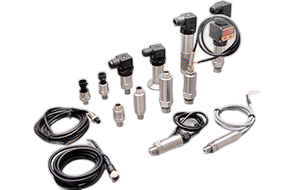
Think of your car (or a complex machine) as a bustling party. You’ve got:
- The Engine (the life of the party, maybe a bit loud)
- The Brakes (serious and safety-conscious)
- The Airbags (hopefully quiet, but ready for action)
- The Dashboard (trying to keep track of everything)
- Sensors Everywhere! (Temperature sensors, speed sensors, pressure sensors – the wallflowers quietly observing)
Now, all these “guests” need to talk to each other quickly and reliably. “Engine, you’re getting too hot!” “Brakes, I’m applying pressure now!” “Dashboard, show the driver the tire pressure!”
This is where CAN Bus and CAN Open pressure sensor comes in.
CAN Bus: The Party Line Phone System
What it is CAN Bus
CAN (Controller Area Network) is a powerful serial bus system for a fast data exchange between electronic control units (ECUs). It has a multi-master functionality so that all CAN nodes send data and different CAN nodes can poll the bus simultaneously.
It was developed by Robert Bosch GmbH in 1983, initially for automotive technology. In addition to passenger cars and commercial vehicles, CAN networks are increasingly used in ships, trains and airplanes as well as in automation technology and mechanical engineering. Today almost all microcontrollers are equipped with a CAN interface.
CAN stands for Controller Area Network. Think of it as the simple, sturdy telephone line installed throughout the entire car (or machine).
How it works
Instead of each guest having a separate phone line to every other guest (messy and expensive!), everyone connects to this one main line – the CAN Bus (usually just two wires twisted together!).
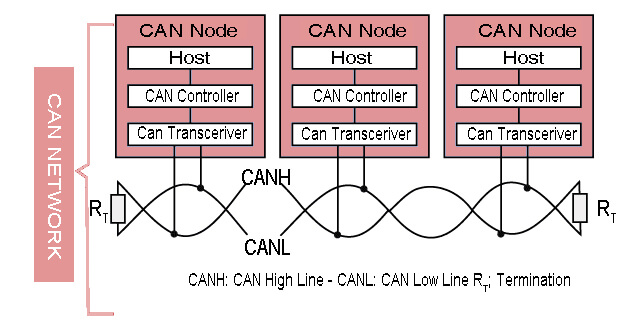
The Rules
It has very strict rules:
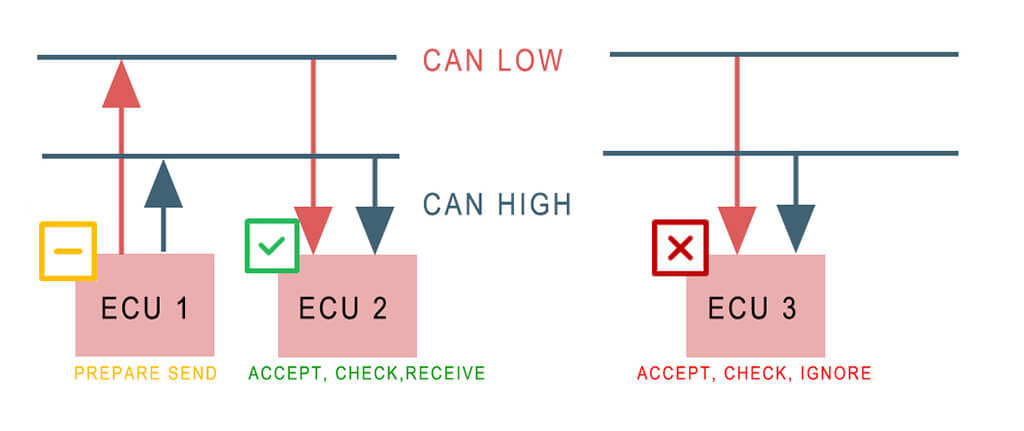
- Only one guest talks at a time. (No shouting over each other!).
- Everyone listens constantly. Even if it’s not addressed to them specifically, they hear everything.
- Messages are short and to the point. “Engine Temp: 95°C”, “Brake Pressure: 45 Bar”.
- It’s super tough. Designed for noisy environments (like under your hood!) – if one message gets garbled, it just sends it again. Safety first!

The Benefit of Can Bus
It’s a cheap, robust way for lots of components to share information without a tangled mess of wires.
- Simple & low cost
- ECUs communicate via a single CAN system instead of via direct complex analogue signal lines -reducing errors, weight, wiring and costs
- Fully centralized
- The CAN bus provides ‘one point-of-entry’ to communicate with all network ECUs – enabling central diagnostics, data logging and configuration.
- Extremely robust
- The system is robust towards electric disturbances and electromagnetic interference – ideal for safety critical applications (e.g. vehicles)
- Efficient
- CAN frames are prioritized by ID so that top priority data gets immediate bus access, without causing interruption of other frames
Popular CAN bus applications
Today, applications for CAN are dominated by the automotive and motor vehicle world, but they are not limited to that. CAN is found across virtually every industry. You can find the CAN protocol being used in:
- Every kind of vehicle: motorcycles, automobiles, trucks…
- Heavy-duty fleet telematics
- Airplanes
- Elevators
- Manufacturing plants of all kinds
- Ships
- Medical equipment
- Predictive maintenance systems
- Washing machines, dryers, and other household appliances.
So, CAN Bus provides the physical wiring and the basic rules for shouting short messages down the line.
Click to find more details of CAN Bus Pressure Sensor in another post.
CANOpen Pressure Sensor
Okay, we have the phone line (CAN Bus). Now, imagine all the party guests speak different languages! The Engine shouts its temperature in Fahrenheit, the Brakes report pressure in PSI, the Dashboard expects Celsius and Bar. Chaos!
What is CANOpen?
CANOpen is a CAN-based protocol for higher layers which was developed by Bosch as embedded network with flexible configuration stability and handed over to the CAN in Automation (CiA) association in 1995.
The CANOpen standard is useful as it enables off-the-shelf interoperability between devices (nodes) in e.g. industrial machinery. Further, it provides standard methods for configuring devices – also after installation. CANOpen was originally designed for motion-oriented machine control systems.
Today, CANOpen is extensively used in motor control (stepper/servomotors) – but also a wide range of other applications including medicine, commercial vehicles, marine electronics or building automation.
| Robotics |
|---|
| Automated robotic, conveyor belt and other industrial machinery |
 |
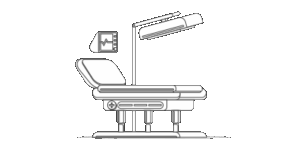
| Medical |
| X-ray generator, injectors, patient tables and dialysis devices |
 |
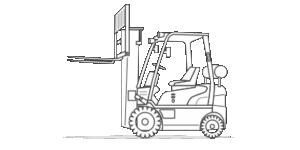
| Automotive |
| Agriculture, railway, trailer, heavy duty, mining, marine and more |
 |
CANOpen is a “higher payer protocol” based on CAN bus, this means that CAN bus (ISO 11898) serves as the “transport vehicle” (like a truck) for CANOpen messages (like containers), below it’s the view of CANOpen from a 7-layer OSI model.

CANOpen is a communication protocol built on top of the CAN Bus.
Think of it as the common language and rulebook everyone at the party agrees to use.
How CanOpen works
It defines:
- A Standard Dictionary: What words mean. “Object Dictionary 0x6400” might mean “Hydraulic Pressure Reading”. Everyone knows this code means pressure.
- Units: How to say it. “Value: 4500” might mean 45.00 Bar (because the dictionary also says the unit and scaling).
- How to Introduce Yourself: When a new device (like a sensor) joins the party, it tells everyone what it is and what data it provides using standard CANOpen messages.
- How to Ask Nicely: The dashboard can send a standard CANOpen message saying “Hey, device with ID #5, please send me your pressure reading!”.
- How to Broadcast: A sensor can shout its reading to everyone automatically at set times (“Heartbeat” or “PDO – Process Data Object” messages).
The Benefit of CanOpen
Plug-and-Play & Interoperability. Because everyone uses the same dictionary and rules:
- You can easily swap a CANOpen sensor from Manufacturer A with one from Manufacturer B (as long as they both speak CANOpen for that type of sensor).
- Engineers can easily connect new devices and understand their data.
- Devices from different companies can work together seamlessly on the same CAN Bus.
So, CANOpen provides the common language, definitions, and higher-level rules for meaningful conversation over the CAN Bus.
CANOpen Pressure Sensor
Now, let’s meet one specific guest: The CANOpen Pressure Sensor.

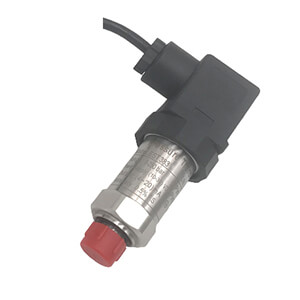
- What it is: It’s a standard pressure sensor (measures gas or liquid pressure like in a hydraulic line, tire, fuel tank, or industrial process) with a built-in CANOpen translator.
- How it works:
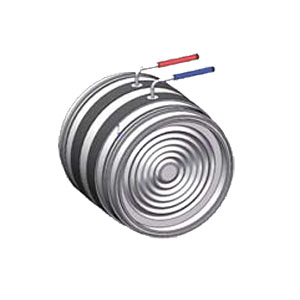
- Senses: Like any pressure sensor, it has a diaphragm or element that physically reacts to pressure.
- Converts: It converts this physical reaction into an electrical signal.
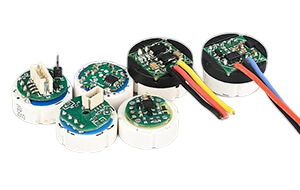
- Translates: Here’s the magic! Instead of just outputting a raw voltage, its built-in electronics translate that signal into standard CANOpen messages.
- Talks CANOpen: It connects directly to the CAN Bus wires. It uses the CANOpen language:
- It has a unique Node ID (like its name tag at the party, e.g., #10).
- It knows its pressure readings belong in a specific slot in the CANOpen “Dictionary” (e.g., Object 0x6400).
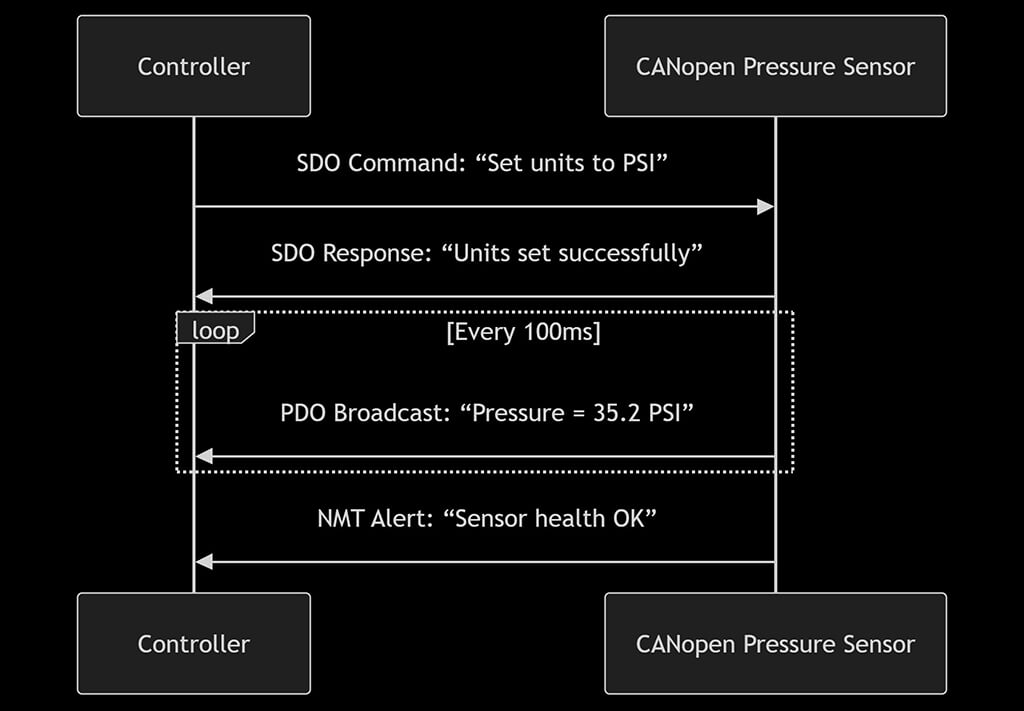
- It can either broadcast its readings periodically (e.g., “Node 10 Pressure: 102.5 Bar”) or respond to specific requests (“Hey Node 10, what’s your pressure right now?”).
- Why it’s Awesome (The Benefits):
-
- Simple Wiring: Just plug its 4 wires (Power, Ground, CAN_High, CAN_Low) into the main CAN Bus trunk line. No miles of individual sensor wires back to a central unit!
- Long Distances: CAN Bus signals can travel reliably much farther than raw analog sensor signals.
- Noise Immunity: The digital CAN signal is much less affected by electrical interference than an analog voltage.
- Plug-and-Play: Need to replace it? Just swap in another CANOpen pressure sensor (with the same dictionary settings). The system recognizes it automatically.
- Smart Diagnostics: It can send error messages over the CAN Bus if something’s wrong with itself (“Node 10 Error: Sensor Fault!”).
- Remote Placement: You can put the sensor right where the pressure needs measuring, even if it’s far away or hard to reach. Only the CAN Bus wires need to run back.
- Network Integration: Its readings are instantly available to any other device on the CANOpen network that needs them (controllers, displays, loggers).
More knowledge about CANOpen Pressure Sensor
What makes it special:
- Digital Communication: Instead of providing just an analog voltage/current output (like 4-20mA or 0-10V), it communicates digitally over the CAN bus using the CANOpen protocol.
- Standardized Interface: It adheres to a specific CANOpen device profile relevant to sensors. The most common profiles are:
- CiA 404 (I/O Modules): Often used for basic analog input devices like pressure sensors. Defines standard Object Dictionary entries for scaling, units, value representation, etc.
- CiA 302 (Programmable Devices): Sometimes used for more complex sensors, offering greater configurability.
- CiA 410 (Generic I/O Modules): A newer profile aiming to replace CiA 404 for enhanced features.
- Vendor-Specific Profile (CiA 4xx): Some manufacturers use their own profile if no standard fits perfectly, but they still implement the core CANOpen services.
- Key Features & Advantages:
- Object Dictionary: Contains entries for:
- The measured pressure value (usually mapped to a PDO for fast transmission).
- Scaling factors (min/max pressure, min/max output value).
- Engineering units (Pa, bar, psi, etc.).
- Device information (vendor ID, product code, revision, serial number).
- Configuration parameters (filter settings, output rate, alarm thresholds).
- Status/error codes.
- PDOs (Process Data Objects): Used to transmit the actual pressure measurement value cyclically or on change (event-driven) with very low latency. This is the primary way the pressure reading is sent to the controller.
- SDOs (Service Data Objects): Used by a master device (like a PLC) to read from or write to the sensor’s Object Dictionary. This is how configuration (setting units, scaling, filter time) and reading detailed status/information is done.
- Reduced Wiring/Cost: Connects directly to the shared CAN bus, eliminating the need for individual analog wires back to the controller and separate power supplies in many cases (if the bus supports power).
- Noise Immunity: Digital signals over CAN are far more resistant to electrical noise than analog signals, leading to more reliable measurements, especially over longer distances or in noisy industrial environments.
- Diagnostics: The sensor can report its health status, errors (e.g., out-of-range, sensor fault), and detailed identification information over the network.
- Multi-vendor Compatibility: If it adheres to a standard profile (like CiA 404), it can be easily replaced or used alongside sensors from other vendors that support the same profile.
- Higher Resolution & Accuracy: Digital transmission avoids the degradation inherent in analog signal transmission (voltage drops, noise pickup).
- Scalability: Easy to add more sensors to the same network without major rewiring.
- Object Dictionary: Contains entries for:
How it Works in a System:
- The sensor is physically connected to the CAN bus (typically a shielded twisted-pair cable) and powered (often via the bus or locally).
- A CANOpen master device (PLC, controller, gateway) discovers the sensor using NMT services.
- The master configures the sensor via SDOs (e.g., sets the pressure unit to bar, configures PDO mapping and transmission type).
- The sensor starts transmitting its pressure value cyclically via PDOs.
- The master receives the PDOs and uses the pressure data.
- The master can periodically check the sensor’s status via Heartbeat or Node Guarding, or read detailed parameters via SDOs.
Benefits of CANOpen Pressure Sensor Over Traditional Sensors
| Feature | Traditional Sensor | CANopen Sensor |
|---|---|---|
| Wiring | Dedicated wires per sensor | ✅ Single shared cable |
| Noise Resistance | Analog signal degrades | ✅ Digital signal immune |
| Configuration | Manual adjustment | ✅ Remote commands |
| Diagnostics | Guesswork | ✅ Self-reporting |
| Scalability | Complex to add sensors | ✅ Plug-and-play |
| Vendor Lock-in | Brand-specific | ✅ Multi-vendor support |
In short: A CANOpen Pressure Sensor takes a physical measurement and turns it into a clear, standardized digital message that plays nicely with all the other devices on the CAN Bus network.
Click to find more details about one of the popular CANOpen pressure sensor EST3607 made by Eastsensor

Next time you see a “Check Engine” light, or marvel at a smoothly running factory, remember the silent, efficient conversation happening over the CAN Bus, guided by the rules of CANOpen, with devices like our trusty pressure sensor diligently reporting in! It’s the hidden network that keeps our complex world running smoothly.
Other CAN Standards
✅ Key Takeaway
CAN isn’t one protocol—it’s a family of rugged, real-time networks. Choose:
- CANOpen for plug-and-play smarts.
- J1939/NMEA for vehicles/boats.
- CAN FD when speed + data volume matter.
Bottom line: CAN’s simplicity and noise immunity keep it unbeatable for machinery. Now you speak its dialects!
Got a project? Match your needs:
- 🤖 Robotics/Medical: CANOpen
- 🚚 Trucks/Tractors: J1939/ISO 11783
- ⚡ EVs/High-speed: CAN FD
- 🏭 Legacy Factories: DeviceNet
FAQ
What’s CANbus?
A rugged 2-wire network (like a “machine nervous system”) that lets devices share data without dedicated wiring.
What does CANOpen add?
A rulebook for CANbus, enabling plug-and-play device communication, diagnostics, and configuration.
How is a CANOpen pressure sensor different?
It sends digital pressure readings (e.g., “35.2 PSI”) over the CANBus instead of fuzzy analog signals.
Why choose it over analog sensors?
✅ Fewer wires (shared bus)
✅ Noise-proof digital signals
✅ Remote configuration (change units/alarms via software)
✅ Self-diagnostics (“I’m faulty!”)
Can I mix brands?
Yes! If sensors follow the same CANOpen profile (e.g., CiA 404), they’re typically cross-compatible.
What industries use these?
Automotive (tire/battery pressure), factories (hydraulics), robotics, medical devices, and energy systems.
Is setup complicated?
Initial CANOpen configuration requires expertise, but daily operation is automated. Worth it for long-term reliability!
Can it work with Ethernet/IP?
Yes—via gateways. CANOpen handles device-level communication; Ethernet links to higher-level systems (like cloud).
How far can signals travel?
Up to 1,000+ meters (vs. ~100m for analog). CANbus’s noise resistance enables long runs.
How to easily understand?
🛣️ CANbus = SHARED WIRING HIGHWAY
📘 CANOpen = UNIVERSAL RULEBOOK
🔍 CANOpen Sensor = SMART TALKING GAUGE
✅ Benefits:
├── Less wiring = 💰 Savings
├── Digital signals = 🛡️ Reliability
├── Remote config = ⚙️ Flexibility
└── Self-diagnostics = ❤️🩹 Peace of mind